








If you have weak WiFi signals in certain rooms, buffering videos, dropped video calls, or slow internet speeds upstairs, you’re not alone. Large homes often struggle with WiFi coverage because a single router cannot effectively reach every room.
Two popular solutions are WiFi Extenders and Mesh WiFi Systems. Both can improve coverage, but they work differently and are designed for different situations.
In this guide, we’ll compare WiFi Extenders and Mesh WiFi systems, explain their pros and cons, and help you choose the best solution for your home.
Why Large Homes Have WiFi Problems
Modern homes contain many obstacles that weaken wireless signals.
Common causes include:
- Thick concrete or brick walls
- Multiple floors
- Long distances from the router
- Metal appliances
- Smart home devices
- Gaming consoles and TVs
- Neighboring WiFi interference
As WiFi signals travel through your home, they become weaker and slower.
This creates what are commonly known as WiFi dead zones.
What Is a WiFi Extender?
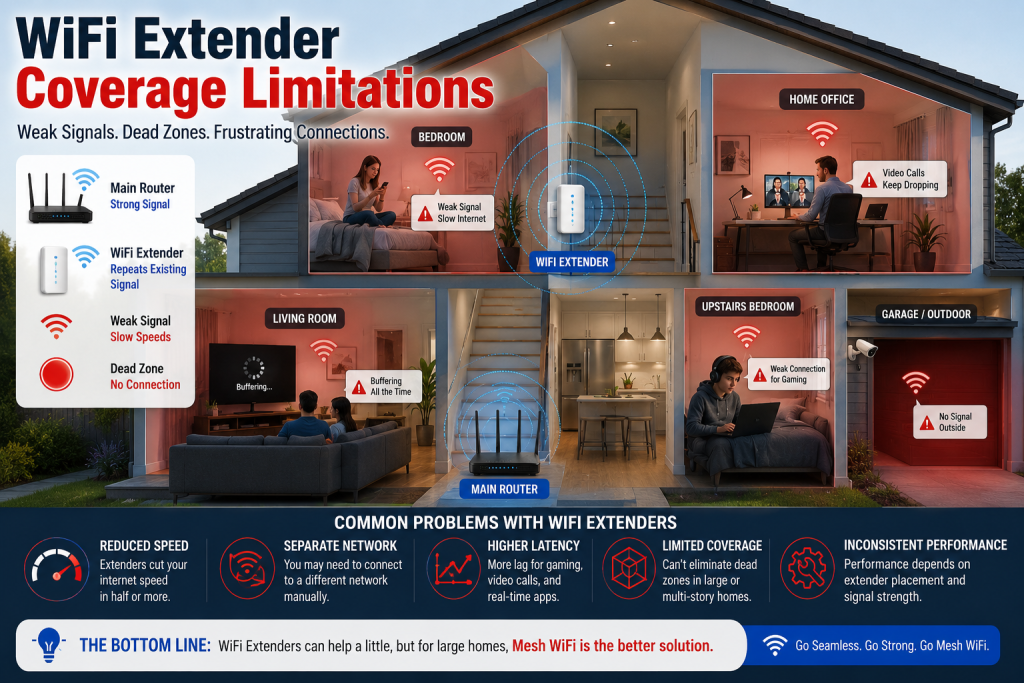
A WiFi Extender (also called a WiFi Repeater) receives your router’s signal and rebroadcasts it to extend coverage.
Think of it as a middleman between your router and devices located far away.
How WiFi Extenders Work
- Router sends WiFi signal
- Extender receives signal
- Extender retransmits signal
- Devices connect through extender
Advantages of WiFi Extenders
✅ Affordable solution
✅ Easy setup
✅ Works with most routers
✅ Ideal for small dead zones
✅ No need to replace existing router
Disadvantages of WiFi Extenders
❌ Reduced internet speed
❌ Separate network names may be required
❌ Limited coverage improvement
❌ Performance varies by placement
❌ Can increase latency
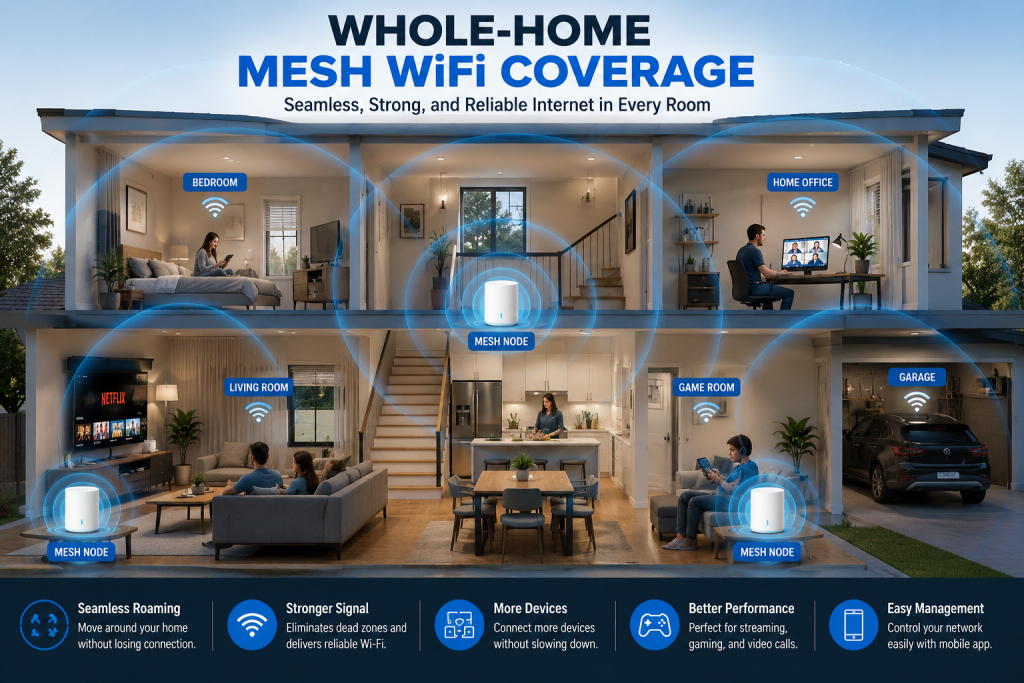
What Is Mesh WiFi?
Mesh WiFi uses multiple nodes that work together to create one seamless wireless network throughout your home.
Instead of extending a signal, Mesh systems create a connected network that intelligently routes traffic between nodes.
Popular Mesh systems include:
- Google Nest WiFi
- TP-Link Deco
- Amazon eero
- ASUS ZenWiFi
- Netgear Orbi
How Mesh WiFi Works
A Mesh system consists of:
- One main router node
- Multiple satellite nodes
Each node communicates with the others to provide complete home coverage.
As you move around the house, your device automatically connects to the strongest node without interruption.
Advantages of Mesh WiFi
✅ Seamless whole-home coverage
✅ Single WiFi network
✅ Automatic device roaming
✅ Better speeds throughout the home
✅ Ideal for smart homes
✅ Excellent for streaming and gaming
✅ Easier management through mobile apps
Disadvantages of Mesh WiFi
❌ More expensive
❌ Requires multiple devices
❌ May be unnecessary for small homes
❌ Some systems have subscription features
WiFi Extender vs Mesh WiFi: Side-by-Side Comparison
| Feature | WiFi Extender | Mesh WiFi |
|---|---|---|
| Coverage | Moderate | Excellent |
| Internet Speed | Often Reduced | More Consistent |
| Setup Process | Easy | Easy |
| Cost | Lower | Higher |
| Roaming Between Rooms | Limited | Seamless |
| Gaming Performance | Average | Excellent |
| Video Streaming | Good | Excellent |
| Large Homes | Fair | Best Choice |
| Multi-Story Homes | Limited | Excellent |
| Smart Home Support | Fair | Excellent |
| Recommended For | Single WiFi Dead Zones | Whole-Home Coverage |
Which Is Better for Large Homes?
For homes larger than 2,000 square feet (185 square meters), Mesh WiFi is usually the better option.
Mesh systems provide:
- Better coverage
- Faster speeds
- More stable connections
- Improved streaming performance
- Better gaming experiences
- Fewer dead zones
If you regularly use:
- Netflix
- YouTube
- Zoom
- Microsoft Teams
- Online gaming
- Smart home devices
Mesh WiFi generally delivers a much better experience.
When Should You Choose a WiFi Extender?
A WiFi Extender is a good choice if:
- You have a small apartment
- Only one room has weak coverage
- Your budget is limited
- Your existing router is relatively new
- You need a quick solution
Example:
If your WiFi works perfectly throughout the house except for one bedroom or home office, a WiFi Extender may solve the problem.
When Should You Choose Mesh WiFi?
Mesh WiFi is ideal if:
- You have a large house
- Multiple floors need coverage
- Several people use the internet simultaneously
- You stream 4K video
- You play online games
- You use smart home devices
- You work remotely
Example:
A two-story home with multiple bedrooms, smart TVs, security cameras, and gaming consoles will benefit significantly from Mesh WiFi.
Best Router Placement Still Matters
Even with a Mesh system, proper router placement remains important.
For best performance:
- Place the main router near the center of the house
- Keep routers elevated
- Avoid metal objects
- Avoid microwaves and cordless phones
- Position antennas correctly
- Keep nodes within range of each other
Proper placement can significantly improve network performance.
Can Mesh WiFi Increase Internet Speed?
Mesh systems cannot increase the speed provided by your ISP.
However, they can:
- Improve signal strength
- Reduce dead zones
- Deliver faster speeds in distant rooms
- Improve reliability
- Reduce buffering
Many users feel their internet is faster simply because coverage improves dramatically.
Best Mesh WiFi Systems in 2026
Popular options include:
Google Nest WiFi Pro
- Easy setup
- Excellent coverage
- User-friendly app
TP-Link Deco XE75
- WiFi 6E support
- Great value
- Excellent performance
Amazon eero Pro 6E
- Strong smart-home integration
- Reliable coverage
Netgear Orbi 970
- Premium performance
- Ideal for large luxury homes
ASUS ZenWiFi XT9
- Excellent gaming performance
- Advanced controls
Final Verdict
If you need to eliminate a single WiFi dead zone, a WiFi Extender can be an affordable solution.
However, if you want fast, reliable internet throughout a large home, Mesh WiFi is usually the better long-term investment.
For most modern households with multiple users, smart devices, streaming services, and remote work requirements, Mesh WiFi delivers superior coverage, performance, and convenience.
A well-designed Mesh network can completely transform your home internet experience.
Frequently Asked Questions About WiFi Extender vs Mesh WiFi
Yes. Mesh WiFi generally provides better coverage, faster speeds, and seamless roaming throughout large homes.
In many cases, yes. Extenders often reduce speed because they retransmit existing wireless signals.
Absolutely. Mesh systems are specifically designed to provide strong coverage across multiple floors.
Most homes require 2–3 nodes, while larger properties may need 4–6 nodes.
Some Mesh systems allow this, while others replace your current router entirely.
Consistent whole-home coverage with a single seamless network.
Yes. Mesh systems often provide lower latency and more stable connections for online gaming.
WiFi Extenders are generally much cheaper, but Mesh systems provide significantly better performance.


