


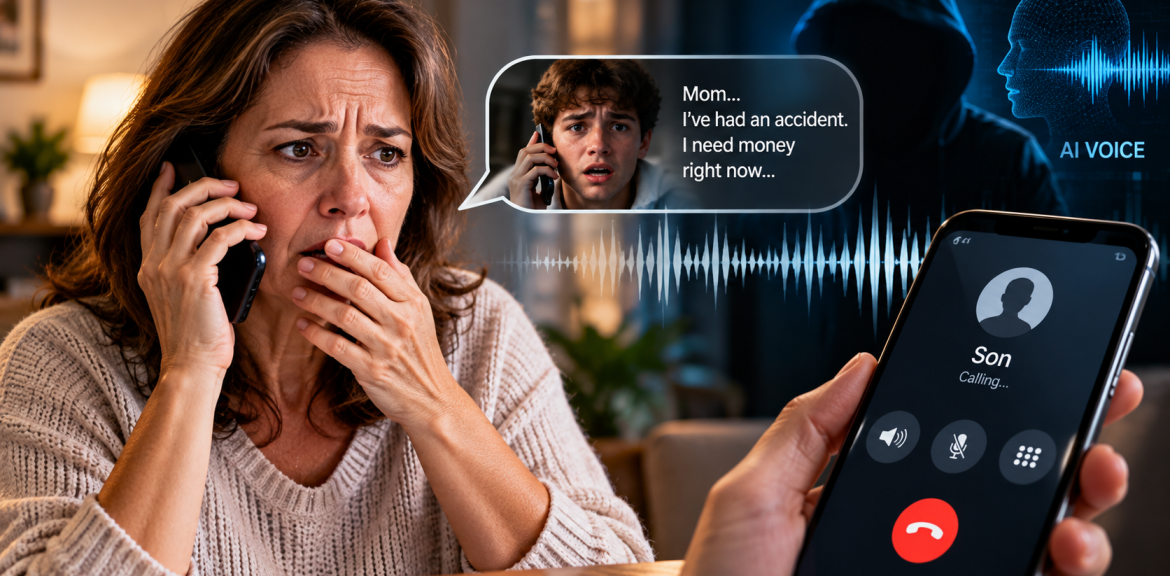

Imagine hearing your child’s voice on the phone: “I’ve had an accident. Please send money. Don’t tell anyone.†The voice sounds familiar, the fear feels real, and the caller insists there is no time to check. But is the person speaking actually your child?
Quick answer: Yes, AI tools can imitate a person’s voice, and criminals can use voice cloning to make a family emergency scam more convincing. However, a familiar-sounding voice does not prove a caller’s identity, and not every emergency scam uses AI. The safest response is to pause, end the call, and contact your loved one through a number you already know before sending money or sharing information.
Updated October 2026 · The Digital Edge | Lanka E-Marketing · Consumer cybersecurity guidance
How can AI clone someone’s voice for a scam?
Voice-cloning technology can learn patterns from recorded speech and produce synthetic audio that resembles a particular speaker. A criminal might obtain publicly available voice clips, create an imitation, and use it during a phone call or recorded message. The US Federal Trade Commission (FTC) has specifically warned that some family emergency scammers use AI to imitate loved ones’ voices.
The technology is only one part of the fraud. The more important tactic is social engineering: creating urgency, fear, secrecy, and a request for money before the recipient has time to verify the story. Criminals can also impersonate relatives without AI, so an unusual accent or robotic sound is not a reliable test.
A realistic example (illustrative, not a reported case)
A parent receives a call late in the evening. A frightened voice says, “Mom, it’s me. I’m in trouble. Please send the money now.†Another person joins, claiming to be a hospital employee or lawyer. The caller insists that telling other relatives will make things worse. The parent is asked to transfer money to an unfamiliar account.
At this point, the key question is not “Does the voice sound real?†It is “Can I independently confirm that this emergency and payment request are genuine?â€
Can scammers really copy a voice from a short recording?
Some voice-cloning systems can produce a convincing imitation from relatively short samples, but the quality varies with the recording, the software, the language, and the circumstances. A scammer may obtain audio from public videos, social posts, voicemail, or other sources. This does not mean every voice clip is enough to create a perfect copy or that posting a video automatically exposes someone to fraud.
Because convincing imitations are possible, voice recognition alone should not be treated as identity verification when someone asks for money, login codes, or sensitive information.
The Family Voice Verification Protocol: four actions before you pay
We use the following four-action checklist as a practical editorial framework for families. It is not an official authentication standard, and no single step is foolproof.
- Pause: Resist urgency. Tell the caller you will verify the situation. Do not send money, read out an OTP, or disclose account details during the call.
- Disconnect: End the call rather than relying on the incoming caller ID. Caller ID can be misleading or spoofed.
- Verify independently: Call your relative using a number already saved in your contacts, or reach them through another trusted channel. If they do not answer, contact someone else who is likely to know where they are. If you have a credible reason to believe someone is in immediate danger, contact the appropriate emergency service through its official number.
- Decide only after confirmation: Check the actual situation and the destination of any requested payment. Never let a caller’s demand for secrecy prevent you from asking another trusted person.
The rule worth remembering: A familiar voice is a clue, not proof. Independent confirmation comes before payment.
Seven warning signs of a fake family emergency call
- The caller demands money immediately and discourages you from hanging up.
- You are told not to contact other relatives, friends, or authorities.
- The story includes a sudden accident, arrest, hospital bill, or travel emergency.
- Someone claiming to be a lawyer, doctor, or police officer takes over the call and increases the pressure.
- Payment is requested through gift cards, cryptocurrency, wire transfers, or an unfamiliar account.
- The caller asks for an OTP, password, banking login, or remote access to your device.
- Details change when you request independent confirmation.
Important: None of these signs alone proves that audio was AI-generated. A real emergency may also involve urgency. The safest approach is to verify the facts through a separate trusted contact method.
Can you tell an AI voice from a real human voice?
Not reliably by listening alone. Some synthetic voices may have awkward pauses or unnatural intonation, but others can sound convincing. Background noise, poor phone connections, stress, and ordinary speech differences can also make genuine voices sound strange. Online “AI voice detector†claims should not replace independent verification.
Instead of asking whether you can detect the technology, ask whether you can verify the person’s identity and the emergency without relying on the suspicious call.
What about a family secret word or question?
A prearranged family phrase can be a useful extra check, especially when everyone understands when to use it. But it is not a replacement for calling back: secrets can be overheard, shared accidentally, guessed, or exposed in messages. Avoid questions whose answers appear on social media, such as birthdays, pets’ names, or school names.
Agree on a simple process: if an unexpected caller asks for money, hang up, use a trusted number, and consult another family member. Treat any secret phrase as one supporting signal, never the only proof.
What if you already sent money or shared information?
Act immediately. Recovery is not guaranteed, but speed matters.
- Contact your bank or payment provider through its official app, card number, or website. Report suspected fraud and ask whether the transaction can be stopped, recalled, disputed, or investigated.
- Protect affected accounts. If you revealed a password or verification code, change the relevant credentials using the official website or app, enable stronger authentication, and follow your bank’s instructions.
- Preserve evidence. Save call times, phone numbers, messages, receipts, transaction references, and screenshots without sharing private codes publicly.
- Warn your relative and family. Tell them someone may be impersonating a loved one so others do not respond to similar requests.
- Report the scam. In the United States, use ReportFraud.ftc.gov. Elsewhere, use your local police, financial-fraud reporting service, and bank’s official fraud channel.
Be wary of people who contact you afterward promising guaranteed recovery in exchange for an upfront fee. That can be a second scam.
A five-minute family safety plan you can set up today
Prevention is easier when everyone knows what to do before an alarming call arrives. Here is a short family exercise:
- Choose two trusted ways to contact each person, such as a saved mobile number and a known messaging account.
- Agree that no one will transfer emergency money solely on the strength of an incoming call or voice message.
- Identify a second relative or friend to contact when the person named in the emergency cannot be reached.
- Discuss a private family phrase as an additional check, while recognising its limitations.
- Make sure older relatives and teenagers know they can hang up, verify, and ask for help without embarrassment.
Try this scenario together: “Someone calls sounding like me and asks for $2,000 urgently. What will you do before paying?†If each family member can answer with an independent verification step, the plan is easier to remember under pressure.
How is an AI voice scam different from a WhatsApp or OTP scam?
All three may rely on impersonation, but the immediate deception differs. A voice-cloning scam tries to make a caller sound familiar; an unexpected WhatsApp verification-code incident may indicate someone is attempting to register an account; and an OTP scam attempts to persuade someone to reveal or approve a security code. None of these warning signs alone confirms a successful account takeover.
For related practical guides, read how QR-code and banking OTP scams work and what to do about WhatsApp verification codes you did not request.
Frequently asked questions about AI voice cloning scams
Can AI copy my voice from a video on social media?
It may be possible to imitate a voice using publicly available recordings, depending on their quality and the tools used. This does not mean every public video results in a usable clone. Use independent verification for unexpected money requests regardless of how convincing the caller sounds.
Can someone steal money just by cloning my voice?
A cloned voice by itself does not automatically withdraw money from a bank account. In family emergency scams, the impersonation is typically used to convince someone to send money or disclose sensitive information. Different fraud schemes may use other methods.
What should I do if my son or daughter calls crying and asks for money?
Take the concern seriously, but end the call and contact them through a number you already know. If they cannot be reached, check with another trusted person. If you have credible evidence of immediate danger, contact emergency services using an official number.
Will a secret family password stop voice-cloning scams?
A private phrase can add a layer of protection, but it is not foolproof. It may be leaked or guessed. Confirm the request through a separate trusted contact method before sending money.
Can I identify an AI-generated voice by how it sounds?
Not reliably. Audio artifacts are inconsistent, and a real voice may sound different over a poor connection. Do not base financial decisions on whether a voice sounds natural.
Where should I report an AI voice-cloning scam?
Report suspected financial fraud promptly to your bank or payment provider and to the appropriate national consumer protection or law-enforcement authority. In the US, the FTC accepts reports at ReportFraud.ftc.gov.
The bottom line
AI voice cloning can make an old family emergency scam more persuasive, but the strongest defence does not depend on detecting AI. Pause. Disconnect. Verify independently. Then decide. Share that process with your family before anyone receives a frightening call.
Sources and editorial transparency
- US FTC: Scammers Use Fake Emergencies to Steal Your Money — family impersonation methods, voice cloning, verification and reporting.
- US FTC: What To Do if You Were Scammed — practical steps following suspected fraud.
Editorial note: This is an educational guide informed by public consumer-protection guidance and editorial analysis. The family call described above is a hypothetical example, not a claimed firsthand incident or an independently investigated case. The “Family Voice Verification Protocol†is our practical editorial checklist, not an official government or bank standard. Rules and reporting channels vary by country. This article does not provide individual financial or legal advice.


