


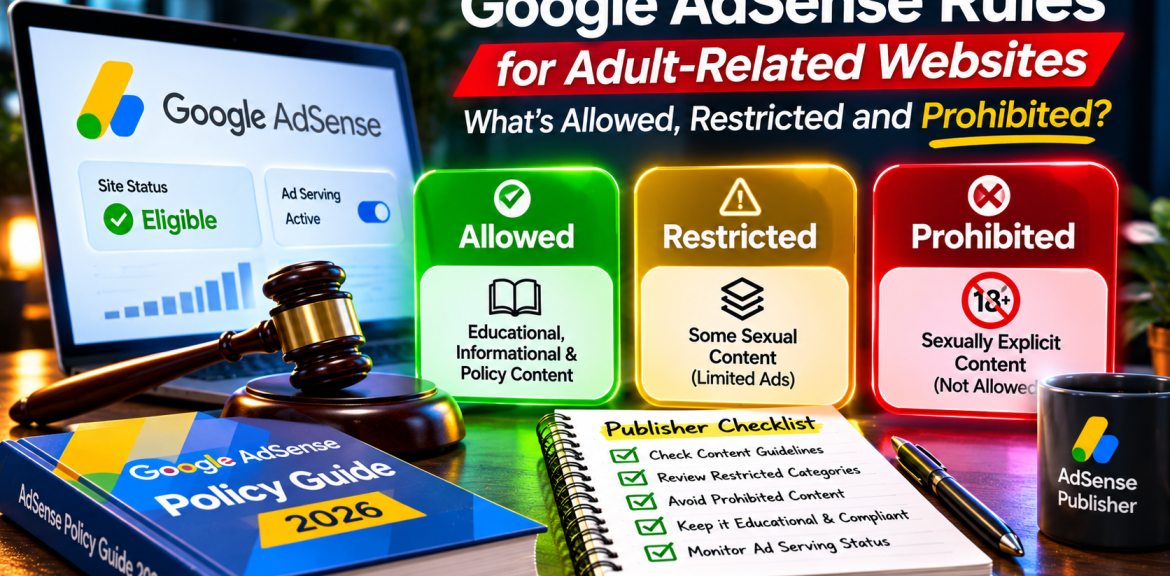

Can a website discussing adult industries use Google AdSense? Sometimes. Google distinguishes prohibited publisher content, which cannot be monetized under its policies, from restricted content, which may receive limited advertising demand. An educational article about SEO for dating platforms or age-restricted retailers is not automatically the same as an explicit or promotional adult-content page. The actual text, images, links and page context matter.
This 2026 guide is for publishers, website owners and digital marketers who need a practical, policy-first way to evaluate pages before placing ads. It does not promise AdSense approval or teach ways to disguise restricted content.
1. The essential distinction: prohibited vs. restricted vs. potentially unrestricted
Google’s Publisher Policies and Publisher Restrictions are separate rule sets. Violating a policy can lead to ads being blocked and account enforcement. Restricted content is not automatically a policy violation, but advertisers and advertising products may decline to serve ads on it.
| Content situation | General treatment | Publisher action |
|---|---|---|
| Graphic sexual text or imagery | Prohibited sexually explicit content under Publisher Policies | Do not place AdSense code on violating content; address the policy issue |
| Sexually suggestive imagery, promotion of sexual merchandise or hookup services | May fall under sexual-content Publisher Restrictions; other policies can also apply | Expect reduced ad demand; review entire page and relevant policies |
| Neutral educational explanation of Google’s advertising rules | May be treated differently from promotional sexual content | Keep presentation genuinely informational; monitor Policy Center |
| Mainstream dating-platform SEO tutorial with non-suggestive visuals | Not automatically prohibited solely because it discusses dating | Review links, screenshots, examples and context; no guarantee of ad eligibility |
Important: This table is an editorial decision aid, not a substitute for Google’s review. Classification is contextual, and multiple policies can apply simultaneously.
2. What does Google prohibit under sexually explicit content rules?
Google’s publisher policies prohibit graphic sexual material and certain other categories, including non-consensual sexual themes and promotion of sexually explicit deepfake creation. Other publisher policies cover compensated sexual acts and additional prohibited material. See the full policy for the current definitions and examples.
Practical implication: Removing an explicit photograph does not necessarily solve a policy issue if the remaining page text, video, links or service being promoted still violates the rules. Evaluate the whole page and the surrounding user experience.
3. What content is restricted rather than prohibited?
Google’s sexual-content restriction includes examples such as sexually suggestive visuals, sexual entertainment, sexual merchandise, hookup-oriented dating and advice about sexual performance. This is not a complete list. Restricted inventory can receive fewer ads, and sometimes none, even when publishing the content is not itself a policy violation.
Google states that Google Ads demand will not serve on inventory labeled with these publisher restrictions; some other sources of demand may remain available. That means high page views do not guarantee high AdSense revenue.
4. Can an educational SEO article about adult businesses earn AdSense revenue?
Potentially, yes—but not automatically. Google illustrates that educational material about sexual topics may be treated differently from sexually suggestive content. An article explaining SafeSearch classification, indexing problems or advertising rules can serve a legitimate informational purpose without promoting sexual activity or products.
For example, a technical guide explaining why an age-verification wall blocks crawlers has a different purpose from a page advertising explicit products. However, a neutral headline alone will not neutralize suggestive photographs, promotional affiliate links or explicit material embedded elsewhere on the page.
Editorial test: is this page explaining or promoting?
- Purpose: Does the page solve a business, technical or policy question?
- Visuals: Are images neutral, professional and necessary to the explanation?
- Links: Are external references authoritative documentation rather than promotional adult destinations?
- Examples: Are screenshots fictionalized or cropped to avoid explicit imagery and private data?
- Accuracy: Are policy statements attributed to the current official documentation?
5. A 15-minute AdSense risk audit before publishing
- Read the full page as a visitor. Include the title, excerpt, featured image, embedded media, comments and related-post widgets.
- Identify the page’s real purpose. An SEO policy tutorial should not quietly function as an adult product advertisement.
- Check prohibited categories first. Compare content with Google’s Publisher Policies; do not rely on a keyword list alone.
- Check restricted categories next. Assess whether sexual-content restrictions may limit demand even if the page is not prohibited.
- Inspect links and ads. Google says page content can include advertisements and outbound links when determining restrictions.
- Review thumbnails and social previews. Avoid sensational or suggestive images that misrepresent an educational article.
- Publish with an accurate title and context. Do not cloak, mislabel or hide material from reviewers.
- Monitor AdSense Policy Center. If Google reports a problem, investigate the specific affected pages and the stated issue.
6. What to do when AdSense reports a policy issue
| What you see | What it may mean | Next action |
|---|---|---|
| Policy violation | Content or implementation may breach a publisher policy | Read the specific finding; correct or remove violating content; follow available review process |
| Publisher restriction / advertiser preference | Page may be eligible for fewer sources of advertising | Assess whether content truly fits the restriction; adjust only if editorially appropriate |
| No ads showing, no clear issue | Demand, technical setup, consent, inventory or other factors may be involved | Check Policy Center, ad implementation, consent requirements and reporting |
| Traffic rising, revenue flat | Audience geography, ad demand, page RPM and restricted inventory may differ | Compare page-level revenue, geography and policy status instead of assuming an SEO failure |
Google explains the difference between publisher-policy violations and publisher restrictions. A restriction by itself is not the same as an account violation.
7. Can AdSense restrictions affect Google Search rankings?
Do not confuse the systems. Google Search indexing and ranking, Google Ads advertiser eligibility and AdSense publisher monetization have different purposes and rules. A page receiving limited advertising demand does not, by that fact alone, prove it has suffered a Google Search ranking penalty.
Investigate Search visibility with Google Search Console and monetization with AdSense reporting and Policy Center. For a separate technical issue, see our guide to Google SafeSearch filtering and SEO visibility (verify the live URL before publishing).
8. Does Google AI Search treat these pages differently?
Google’s Search Central documentation says the core SEO principles also apply to AI Overviews and AI Mode. A page generally needs to be indexed and eligible to appear in Search with a snippet to qualify as a supporting link; there is no special AI markup that guarantees inclusion. Original, helpful explanations and sound site architecture are more useful than producing repetitive keyword variations.
For this topic, give readers a clear answer, quote or link to the actual policy, explain the practical consequence and include a decision table that adds value. Review Google’s AI features and your website guidance.
9. A realistic revenue strategy for policy-focused publishers
Do not build an AdSense forecast from the assumption that adult-industry keywords pay more. Instead, compare qualified search impressions, clicks, engaged sessions, page RPM, country mix and policy status for each article. A technical question with modest traffic may be more valuable to a digital marketing agency than a broad query with irrelevant visitors.
- Publish genuinely useful technical guides, not keyword-swapped duplicates.
- Use original audits, anonymized examples or documented testing when available; do not invent case studies.
- Link related articles where they genuinely help the reader.
- Keep a dated policy-review log because Google can revise rules.
- Use AdSense revenue and potential qualified agency inquiries as separate measures of success.
Related reading: Can adult websites rank on Google?, dating website SEO, and Google Ads policies for dating businesses. Confirm each destination is live before publishing.
10. Frequently asked questions
Does the word “adult†in a blog title automatically violate AdSense policy?
No automatic conclusion follows from a single word. Google evaluates the content and context. A neutral educational article should still be reviewed for imagery, links and other page elements.
Can Google AdSense show ads on dating website SEO articles?
Potentially. A professional article about dating-platform SEO is different from promoting hookup services, but the specific page may still trigger restrictions or other policies.
Is sexually suggestive content prohibited or restricted?
Google lists various sexually suggestive content under Publisher Restrictions, while graphic sexually explicit content is prohibited under Publisher Policies. The exact material and context determine which rules apply.
Will restricted content always show no ads?
No. Google says restricted inventory can receive limited demand, and sometimes no ads. Revenue cannot be predicted solely from a content label.
Can changing a category name fix an AdSense restriction?
Not reliably. Category names are only one contextual signal. Changing labels without changing the underlying material does not make restricted or prohibited content compliant.
Does a Google Ads rejection mean my AdSense account is at risk?
Not necessarily. Google Ads and AdSense have different policies and review systems. Investigate the exact notice in the relevant product.
Can an AdSense restriction cause a SafeSearch filter?
These are separate systems. Similar content may raise different issues in each, but an AdSense notice alone does not establish SafeSearch classification.
How can I tell if an article is earning worthwhile revenue?
Review page-level AdSense reporting where available, policy status, search traffic, geography and page RPM over a meaningful period. Compare similar content rather than assuming every visitor has the same value.
11. Final takeaway
Google AdSense does not treat every adult-related topic identically. The critical distinctions are prohibited material, restricted content and genuinely educational pages whose treatment depends on context. For publishers seeking sustainable income, accurate policy interpretation and useful content are safer long-term strategies than provocative images, misleading labels or high-volume keyword chasing.
Official sources and further reading
- Google Publisher Policies
- Google Publisher Restrictions
- Sexual content restriction and educational examples
- Understanding publisher policies and restrictions
- AI features and your website — Google Search Central
Editorial note: Google policies and product behavior may change. This article explains published guidance as reviewed in November 2026 and is not a guarantee of account approval, ad serving or rankings.


