


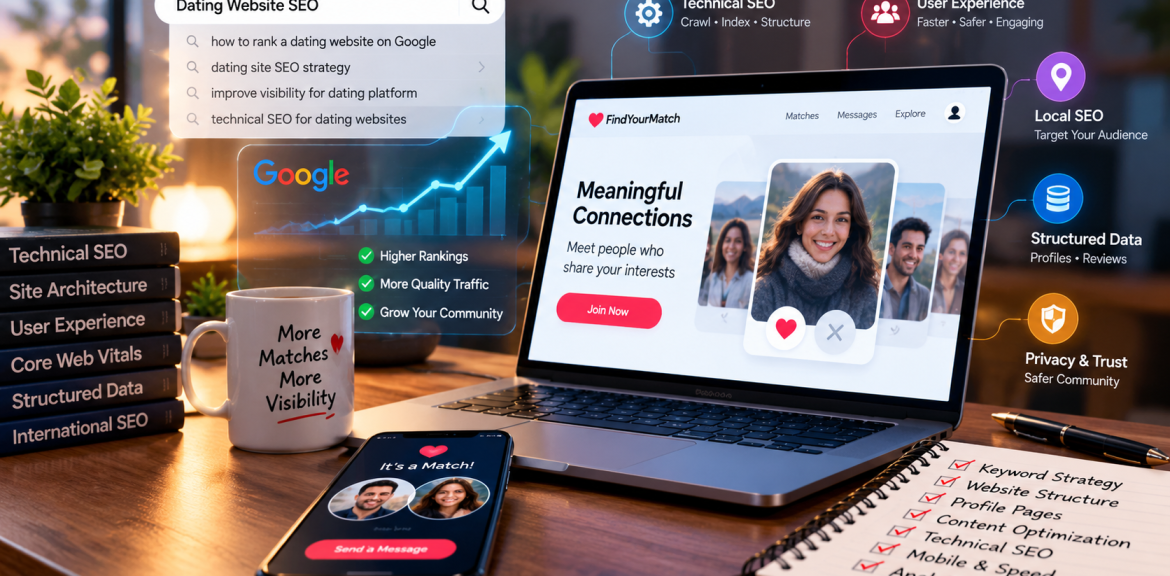

Can a dating website rank on Google in 2026? Yes. Dating platforms can compete for relevant organic search queries, but visibility depends on crawlability, useful and trustworthy pages, search intent, technical performance and competition. A dating site’s organic ranking is a separate question from whether its advertisements qualify for Google Ads or whether its pages qualify for AdSense monetization.
This practical guide is for founders, web developers and digital marketers operating legitimate, consenting-adult dating or matchmaking services. It focuses on sustainable search visibility—not explicit content, misleading profiles or manipulative SEO shortcuts.
Dating website SEO: the short answer
Dating website SEO is the process of making a legitimate dating or matchmaking service discoverable, understandable and useful to people searching on Google. The fundamentals are the same as other industries: technically accessible pages, distinctive content, credible information, relevant links and a good user experience. Dating platforms add special challenges around privacy, user-generated content, trust, geographic relevance and sometimes SafeSearch classification.
1. Start with the right search intent—not the broadest keyword
Someone searching “dating app†may want to download a well-known product. Someone searching “dating website for professionals in Toronto†may want to compare services. Someone asking “how does matchmaking work?†may want an explanation. These queries need different pages.
| Search intent | Example query | Best page type |
|---|---|---|
| Brand/navigation | [brand] dating login | Official home or sign-in page |
| Service comparison | dating app vs matchmaking service | Evidence-based comparison guide |
| Location | matchmaking service in Manchester | Genuine location/service page |
| Safety | how to spot fake dating profiles | Practical safety resource |
| Pricing | how much does matchmaking cost | Transparent pricing explanation |
Action: Build a keyword-to-page map. Assign one main purpose to each important page, and avoid publishing many near-identical pages targeting slight keyword variations.
2. Make public pages crawlable without exposing private member data
Google can only evaluate content it can access. Public pages should return the correct HTTP status, use crawlable links and avoid accidental noindex tags. However, private profiles, direct messages, account settings and sensitive personal information should not be exposed merely to increase search traffic.
- Allow Googlebot to access public informational pages, service descriptions, help articles and genuinely useful location pages.
- Keep private messages and non-public account areas behind authentication; do not expose personal information in public sitemaps.
- Use canonical URLs where the same public content is accessible through multiple URLs.
- Check Search Console’s indexing reports and URL Inspection for unexpected exclusions.
- Test mobile usability, load performance and any JavaScript-rendered public content.
If the service includes age-restricted or explicit sections, review Google’s guidelines for sites with explicit content. Google explains that age gates can prevent crawling and that explicit and non-explicit sections may need clear separation. This is not a reason to remove legal age protections for human visitors.
3. Build pages that answer genuine customer questions
A strong dating platform needs more than a home page and registration button. Useful public content can explain eligibility, who the service is for, how matching works, pricing, cancellations, privacy controls, moderation and reporting processes. These pages reduce uncertainty before signup and can answer informational search queries.
Examples of genuinely helpful pages
- How matching works: Describe the actual process, limitations and what users can expect.
- Pricing and membership: Explain free versus paid features, renewals and cancellation clearly.
- Safety centre: Explain how to report impersonation, harassment and suspicious profiles.
- Privacy: Explain visibility settings, profile removal and data handling in accessible language.
- Service comparisons: Explain differences between online dating, curated matchmaking and local events without invented performance claims.
Avoid claiming “verified members,†“guaranteed matches,†or “highest success rate†unless those claims are accurate and supported by evidence.
4. Handle local SEO without creating doorway pages
Local intent can be valuable for matchmaking agencies that truly serve specific cities. Create a city page only when it offers distinct, verifiable information: service availability, local consultation arrangements, relevant events or genuine local FAQs. Swapping city names in the same template across hundreds of pages adds little value and can resemble doorway or scaled-content abuse.
For a business with an eligible real-world presence, maintain accurate business information and assess whether a Google Business Profile is appropriate under its current guidelines. Do not invent offices or addresses to target more cities.
5. Treat trust and user safety as part of SEO quality
Dating services ask users to make decisions involving identity, relationships, personal data and sometimes money. A trustworthy public website should clearly identify the business, provide accessible support, publish accurate terms and privacy information, and explain how it responds to abuse reports.
Moderate user-generated public content, prevent spam profiles from producing indexable junk pages, and make sure reviews and testimonials are genuine and used with permission. Do not publish identifiable member stories without valid consent.
6. Improve the technical experience on mobile
Many visitors will arrive on phones. Check that the first screen explains the service, buttons are easy to use, signup requirements are clear, and important information remains visible without an app install. Reduce unnecessary scripts and oversized media. Make forms accessible, avoid intrusive interstitials and test critical user journeys on slower connections.
For public content, use descriptive titles, one clear main heading, concise introductions, relevant internal links and meaningful image alt text. Structured data should describe only what is genuinely present on the page; adding markup does not guarantee a special Google result.
7. Earn relevant authority rather than buying spam links
Legitimate mentions may come from local media, consumer-safety resources, relevant podcasts, professional associations or original research about online dating safety and user experience. Publish findings only when your methodology and data rights are sound. Avoid link schemes, mass guest-post networks and fabricated testimonials.
8. Separate organic SEO, Google Ads and AdSense
| Channel | Question to ask | What to verify |
|---|---|---|
| Google Search | Can public pages rank? | Indexing, relevance, quality, SafeSearch where applicable |
| Google Ads | Can the dating service run paid campaigns? | Current dating/companionship advertising policy, certification and geography |
| Google AdSense | Can a publisher monetize a page discussing dating? | Publisher Policies, sexual-content restrictions and page context |
These are different policy systems. Organic visibility does not confer advertising approval. Google publisher restrictions may limit advertising demand on sexual content; explicit sexual content can violate publisher policies. A neutral educational SEO guide should not promote sexual encounters or explicit services. Review the official Google Publisher Policies and sexual-content restrictions before monetization decisions.
9. A practical 30-day dating website SEO plan
| Period | Priority | Deliverable |
|---|---|---|
| Days 1–7 | Technical audit | Indexing review, public/private URL map, mobile checks |
| Days 8–14 | Search intent | Keyword map, page titles, content gap inventory |
| Days 15–21 | Trust and content | Improve matching, pricing, safety and support pages |
| Days 22–30 | Measurement | Internal links, Search Console baseline, conversion tracking |
Measure non-branded impressions, qualified organic clicks, relevant landing-page engagement and completed legitimate signups. Treat a rise in impressions without meaningful conversions as a signal to investigate—not proof that the strategy is working.
10. How to make dating-site content useful for AI-assisted search
AI search systems may surface concise answers to detailed questions. A dating platform can help readers by explaining its process clearly, using accurate headings, publishing firsthand information and making factual claims verifiable. There is no guaranteed method to force inclusion in Google AI Overviews or other AI answers. Google’s generative AI search guidance emphasizes strong SEO fundamentals and unique value over special AI-optimization tricks.
For example, instead of publishing a generic page called “Dating Tips,†answer a concrete question such as “What information does a matchmaking service verify before introducing members?†Only describe checks the actual service performs.
Dating website SEO troubleshooting
| Symptom | Possible cause | First check |
|---|---|---|
| Important page absent from Google | Indexing directive, access or quality issue | URL Inspection and server response |
| Many indexed pages, few clicks | Weak intent fit or uncompetitive content | Search Console queries and page purpose |
| Location pages receive no traffic | Thin duplicate pages or little local relevance | Unique value and real service coverage |
| Signups are low despite clicks | Mismatch between query and offer | Landing page clarity, pricing, signup friction |
| Pages unexpectedly filtered | Possible SafeSearch classification | Google’s explicit-content troubleshooting guidance |
Frequently asked questions
Can dating websites rank organically on Google?
Yes. Legitimate dating and matchmaking websites can appear in organic search results when their pages are eligible for indexing and relevant to searchers. Ranking is not guaranteed.
What is the best keyword for dating website SEO?
There is no universal best keyword. Choose phrases based on the actual service, audience, location and search intent. A niche or local query can be more relevant than a broad phrase such as “dating app.â€
Should dating websites index member profiles?
Not by default. Privacy, consent and safety come first. Keep private or sensitive member information out of search results and index only public pages with a legitimate reason to be searchable.
Can a dating site rank without a blog?
Yes. Helpful service, pricing, safety and location pages can rank. A blog is useful only when it adds original answers that potential customers genuinely need.
Does SafeSearch block every dating website?
No. Dating and explicit content are not identical. SafeSearch filtering depends on Google’s classification and the nature of content; a mainstream matchmaking site should not automatically be treated as explicit.
Can dating websites use Google Ads?
Some dating and companionship services may be eligible subject to Google’s current advertising rules, certification requirements and geographic restrictions. Check the applicable Google Ads policy before launching.
Will adding FAQ schema guarantee AI Overview visibility?
No. Structured data must match visible content and comply with Google policies. Neither FAQ markup nor any special content format guarantees AI citation or a rich result.
Final takeaway
Successful dating website SEO is not about stuffing pages with “dating†keywords. It is about helping the right people discover a credible service, understand how it works, assess its safety and take an informed next step. Build a crawlable public site, protect private data, answer real questions and measure qualified outcomes.
Related reading: Can Adult Websites Rank on Google? SEO, SafeSearch & Advertising Rules and Why Is My Website Not Showing on Google? 10 Things to Check First.
Official references
- Google Search Central: Creating helpful, reliable, people-first content
- Google Search Central: Guidelines for sites with explicit content
- Google Search Central: Optimizing for generative AI features
- Google AdSense: Publisher Policies
- Google Publisher Restrictions: Sexual content
Editorial note: This is general digital marketing information, not legal advice. Advertising and privacy requirements vary by jurisdiction and can change. Last reviewed: October 2026.


