


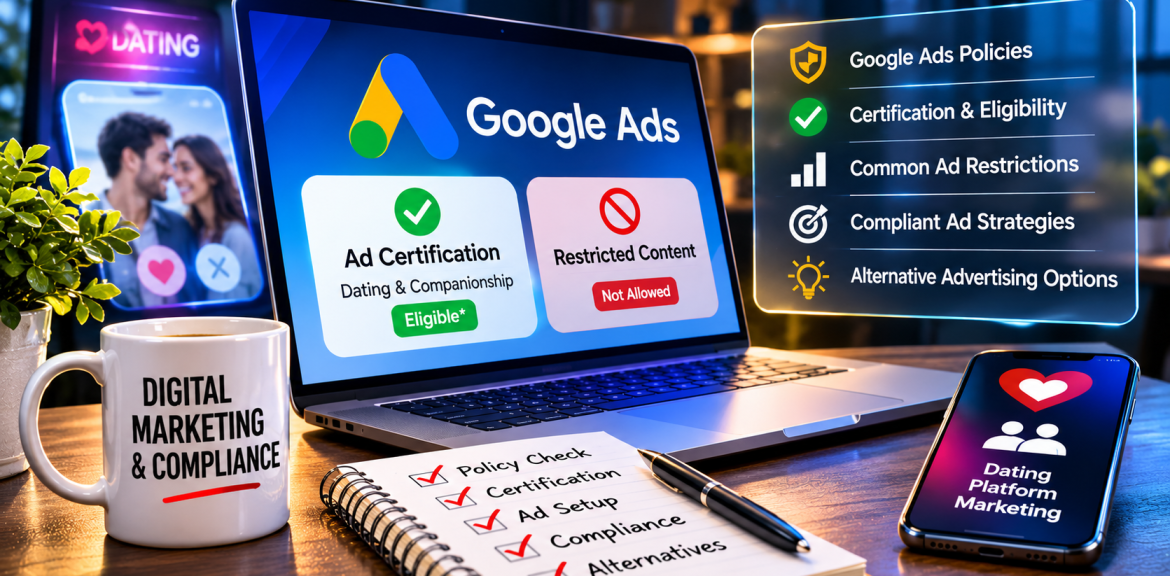

Can dating websites and adult-oriented businesses advertise on Google Ads in 2026? Some can—but eligibility depends on the exact business model, the ad and landing-page content, Google certification, the campaign format, and the countries where ads would appear. General dating services may advertise after certification; certain dating categories face stricter limits; and some services are prohibited. An adult-oriented online store must also check Google’s separate sexual-content advertising rules.
This practical guide is written for business owners, advertising agencies and website developers. It explains what to check before spending on campaigns, why ads are disapproved, and which legitimate marketing channels may still be worth considering. It does not recommend disguising prohibited products, misrepresenting landing pages, or evading Google policy reviews.
1. Are dating websites allowed to advertise on Google?
Yes, some dating and companionship services are eligible if they meet Google’s requirements and receive the appropriate certification. Google separates general dating, restricted dating, and prohibited dating or companionship. These categories do not receive the same ad inventory or geographic eligibility.
| Business or content type | Google Ads treatment | What an advertiser should do |
|---|---|---|
| General dating, matchmaking or matrimonial service | Potentially permitted with certification and age/country restrictions | Check certification, user age controls and landing-page content |
| Dating comparison or aggregator website | Restricted dating category | Check the restricted certificate and eligible campaign inventory |
| Dating focused on sexual encounters, or suggestive dating creative | Restricted dating category, subject to further policies | Review exact content and restrictions; do not assume approval |
| Compensated dating or escort services | Prohibited under Google’s dating policy | Do not submit prohibited promotions |
| Dating service using undisclosed synthetic profiles or chatbots | Prohibited deceptive dating practice | Disclose synthetic interactions clearly and review the policy |
These are simplified examples, not approval guarantees. Google reviews ads, landing pages and potentially content behind a login. Read the official Dating and Companionship policy before launching.
2. Does Google Ads require dating website certification?
Yes. Google requires certification for advertisers promoting dating and companionship products, services or content. General and restricted dating have distinct certificates, with different potential placements. An advertiser may need to supply its Google Ads customer ID, relevant app IDs or landing-page domains, and test credentials so Google can review areas that require an account.
Certification preparation checklist
- Confirm whether the business is general or restricted dating under the published definitions.
- Ensure the service excludes users under 18 and complies with applicable laws.
- Review every advertising destination, including signup screens and logged-in areas.
- Disclose AI-generated profiles or chatbot interactions clearly when used.
- Prepare accessible test credentials if Google needs to review private pages.
- Apply using the process linked from Google’s dating advertising policy and wait for a decision.
Important: Certification is a prerequisite, not a promise that every campaign, creative, keyword or country will be approved.
3. Which countries restrict dating advertisements?
Google’s policy states that dating and companionship ads are not eligible to serve in Sri Lanka and certain other countries. Its current list also includes Algeria, Bahrain, Palestine, Iraq, Jordan, Kuwait, Lebanon, Libya, Morocco, Oman, Nepal, Pakistan, Qatar, Saudi Arabia, Tunisia, Egypt and Yemen. The list can change; check it when planning a campaign.
Example: A dating business based in Sri Lanka should not assume that it can run dating ads to Sri Lankan users. Likewise, an advertiser located elsewhere must still respect restrictions in the target market. Google also applies user-age, local-law, SafeSearch and content-related limits in otherwise eligible markets.
Source: Google’s dating policy and country restrictions.
4. Can adult-oriented online stores use Google Ads?
Sometimes, but not every product or creative is eligible. Google has a separate Sexual Content advertising policy that distinguishes restricted categories, ad formats and eligible networks. The exact product, imagery, wording, destination and local rules matter. Some content is prohibited under Google’s broader inappropriate-content policies.
Do not assume that a product’s organic Google ranking makes its advertising permissible. Similarly, a product’s appearance in Google Shopping or Merchant Center systems is governed by other product-listing policies. Review those requirements separately.
Three checks before launching a product campaign
- Product: Is the item or service eligible to advertise in the target country?
- Creative and landing page: Does the ad text, imagery and destination comply with the applicable content policies?
- Campaign format: Does the relevant policy allow the network and format you intend to use?
A neutral-looking ad is not a workaround if the destination promotes prohibited content. Google evaluates more than the visible headline.
5. Why does Google disapprove dating or adult-business ads?
| Issue shown or suspected | What to investigate | Appropriate response |
|---|---|---|
| Dating certification required | Missing or incorrect certificate | Apply for the appropriate certification |
| Restricted sexual content | Suggestive ad text, imagery or destination | Review the exact policy and eligible inventory |
| Destination mismatch | Ad promises something different from the landing page | Make the ad and destination truthful and consistent |
| Age or location restrictions | Under-18 eligibility or ineligible target market | Correct targeting and site eligibility; do not circumvent restrictions |
| Misrepresentation or deceptive profiles | Undisclosed synthetic users, misleading claims | Correct disclosures and the underlying experience |
| Prohibited business model | Service itself is not permitted | Do not advertise that service through Google Ads |
Use the specific policy label shown in your Google Ads account rather than guessing. Where a compliant ad was disapproved in error, Google’s review and appeal process is the appropriate route. Repeatedly creating replacement accounts or hiding the real destination is not a solution.
6. Google Search, Google Ads and AdSense: three different decisions
This distinction is especially important for website owners who earn advertising revenue from educational blogs.
| Google product | Primary question | Why it matters |
|---|---|---|
| Organic Google Search | Can the page be crawled, indexed and ranked for relevant searches? | Search visibility does not imply ad approval |
| Google Ads | Can the business pay to promote this product, service or destination? | Advertising policies, certification and targeting apply |
| Google AdSense | Can a publisher display ads beside this page’s content? | Publisher prohibitions and inventory restrictions apply |
Google’s publisher guidance explains that prohibited content cannot be monetized, while restricted content may receive limited or no advertising demand. Google also identifies sexual content as a publisher-restricted category and provides examples distinguishing educational material from restricted material. A professional policy-analysis article is not automatically classified the same way as an explicit promotional page; however, no individual article can be guaranteed unrestricted ad serving.
7. What marketing alternatives can legitimate businesses use?
If a particular Google Ads campaign is restricted, choose channels based on their own policies and the business’s lawful audience—not as a method of concealing prohibited activity.
- Organic SEO: Publish useful, crawlable pages that answer customer and business questions. See our guide to Google rankings and SafeSearch.
- Educational content: Explain how the service works, privacy protections, account security, pricing and support without exaggerated claims.
- Technical SEO: Improve site speed, indexing, canonical URLs, navigation and structured data where appropriate. Our dating website SEO guide covers this in depth.
- Permission-based email: Communicate with opted-in adults, honoring unsubscribe and privacy requirements.
- Partnerships and referrals: Work with relevant, reputable partners where permitted and disclose commercial relationships.
- Other advertising platforms: Review each platform’s actual category rules before investing; eligibility is never assumed.
For lawful online retail, our adult e-commerce SEO guide explains the difference between organic product visibility and Shopping eligibility.
8. A 20-minute Google Ads eligibility audit
- Minutes 0–4: Define the actual product or service and classify it against the official dating and/or sexual-content policy.
- Minutes 4–8: Check the target countries, minimum-age rules, campaign network and format.
- Minutes 8–12: Review certification needs and prepare documentation or test credentials.
- Minutes 12–16: Inspect the entire landing-page journey, including post-login content and disclosures.
- Minutes 16–20: Document policy risks, required changes and the appropriate approval or appeal process.
Decision rule: Launch only after the service and campaign are eligible. If the underlying business model is prohibited, focus on lawful, policy-compliant business operations rather than attempts to get around the restriction.
9. Frequently asked questions
Can I run Google Ads for a dating website in 2026?
Some dating services can advertise after obtaining Google’s dating and companionship certification. Eligibility still depends on the dating category, target country, user age and campaign content.
Do dating apps need Google Ads certification?
Yes. Google requires certification for advertisers promoting dating and companionship products, services or content, including relevant dating apps.
Are Google dating ads allowed in Sri Lanka?
Google’s current dating policy says dating and companionship ads are not eligible to serve in Sri Lanka. Check the latest policy before planning campaigns.
Can a dating comparison website advertise on Google?
Google treats aggregators that list, review or compare dating services as a restricted dating category. Appropriate certification and additional restrictions apply.
Can adult product stores advertise through Google Search Ads?
Eligibility depends on the product, content, destination, location and format under Google’s sexual-content and other advertising policies. Organic ranking does not establish paid-ad eligibility.
Does a Google Ads disapproval mean my website cannot rank organically?
No. Paid advertising approval and organic search ranking are separate systems. A disapproved ad does not, by itself, prove that the website is excluded from organic results.
Can an educational article about adult-industry advertising earn AdSense revenue?
Potentially, but there is no guarantee. Google assesses page content and context under its publisher policies and restrictions. Neutral educational discussion is different from explicit promotion, yet ad demand and policy classification can vary.
What should I do if Google disapproves an eligible ad?
Read the specific policy reason in Google Ads, correct any genuine violation and use Google’s review or appeal process if you believe the decision is mistaken.
Final takeaway
Google Ads is not simply open or closed to every dating or adult-oriented business. The relevant questions are what the service does, which Google policy category applies, whether certification is required, and where and how the campaign will run. Business owners who resolve those questions first can avoid wasted setup work and build a more dependable marketing plan.
For more practical guides on search visibility, website development and digital advertising, explore Lanka E-Marketing’s Digital Edge.
Official sources and policy references
- Google Ads: Dating and Companionship
- Google Ads: Sexual Content
- Google Ads: Inappropriate Content
- AdSense: Publisher Policies versus Restrictions
- Google Publisher Restrictions: Sexual Content
Policy information reviewed 31 October 2026. Google policies and geographic eligibility can change; confirm the current rules before submitting an advertising campaign.


