



We have a problem.
The internet doesn’t need another article explaining how to “rank in AI search.”
There are already plenty of them.
Some recommend new content formats. Some focus on schema. Some tell publishers to answer every possible question an AI system might generate. Others promise frameworks for getting cited by ChatGPT, Gemini or Google’s AI features.
We could publish another list.
Instead, we’re going to test something.
For the next 90 days, The Digital Edge will try to grow organic search visibility without turning Lanka E-Marketing into an AI-content factory.
No mass publishing. No invented research. No hundreds of near-identical keyword pages. No buying links for the experiment. And no pretending we know exactly why an AI system chooses one source over another.
Google Search comes first. AI visibility comes second. Real business value matters more than either.
We don’t know what the result will be.
That’s the reason for running the experiment.
The Question We’re Actually Trying to Answer
The question isn’t whether a brand-new website can suddenly dominate Google in 90 days.
Lanka E-Marketing isn’t a new domain, and pretending otherwise would make the experiment more dramatic but less useful.
The website already exists and has an established commercial search presence around digital marketing services.
What’s relatively new is The Digital Edge as a serious publishing project.
That gives us a more practical question:
Can an established small-business website build a meaningful new informational search audience by publishing fewer, more original resources instead of joining the race to produce more AI content?
And because search itself is changing, we’ll watch what happens outside traditional blue-link rankings too.
If the same content begins appearing in Google’s generative search experiences or other AI systems, we’ll document that separately.
But we aren’t going to redefine success just because an AI system mentions us once.
Why Run This Experiment Now?
Publishing has become extraordinarily easy.
Give an AI tool a keyword, ask for 2,000 words, generate a featured image and a publisher can have another article online before lunch.
Technically, that’s impressive.
Editorially, it creates another problem.
If ten publishers use similar source material, similar prompts and similar optimization advice, they can produce ten different articles that contribute almost the same information.
The wording may be original.
The information isn’t.
That distinction is becoming increasingly important to how we think about content at The Digital Edge.
Google’s spam policies don’t prohibit content simply because generative AI was involved. The concern is scaled content created primarily to manipulate rankings rather than help users, particularly when large quantities of unoriginal pages add little or no value.
Source: Google Search Central — Scaled content abuse.
So our experiment isn’t really about whether AI can write.
Of course it can.
The more interesting question is whether a small publisher can use AI as part of the workflow while still producing pages that contain something genuinely worth finding.
Our Working Principle: Information Gain Before Content Volume
We’re introducing a simple editorial rule for this experiment.
Every important Digital Edge article must contribute something we couldn’t get simply by rewriting the pages already ranking for the topic.
We’re calling that contribution the page’s Information Gain.
This is our editorial label. It is not a Google score, ranking factor or metric available in Search Console.
Its purpose is to force us to answer one uncomfortable question before publishing:
What did we add?
The answer might be:
- first-party data
- a real experiment
- an original framework
- practical experience
- a new comparison
- an independently verified observation
- a clearer way of separating known facts from assumptions
If we can’t identify the contribution, publishing another article may not be the best use of our time.
We Have Already Started
This experiment formally begins with Article #3, but the editorial idea behind it began with the first two articles in the relaunched Digital Edge.
In SEO vs AEO vs GEO in 2026: What Actually Matters When Search Starts Answering Back?, we introduced the Digital Visibility Stack:
Discover → Retrieve → Select → Cite → Act
The objective wasn’t to invent another SEO acronym.
It was to show that SEO, answer visibility and generative search visibility increasingly describe different stages of a larger discovery journey.
Then, in How Google AI Mode Finds Sources in 2026: What Google Confirms—and What SEOs Are Guessing, we introduced an Evidence Ladder for AI-search research:
Google Confirmed → Independent Evidence → Reasonable Inference → Still Unknown
That framework exists because too much discussion about AI search presents observations and theories with the same certainty as documented facts.
Article #3 adds a third layer:
Can this publishing philosophy produce measurable results?
Now we have to test it.
The Six Rules of Our 90-Day Test
Rule 1: No Mass AI Publishing
We won’t attempt to win by publishing dozens of AI-generated articles every week.
Publishing frequency may vary because the contribution matters more than hitting an arbitrary content quota.
Rule 2: No Page for Every Keyword Variation
We will research queries, related questions and search intent.
But we won’t turn every variation into another page simply because a keyword tool says it exists.
If several questions belong together, they should probably be answered together.
Rule 3: No Purchased Backlinks for the Experiment
We aren’t claiming links don’t matter.
We’re removing one variable.
During the test, we won’t purchase backlinks specifically to push these Digital Edge articles upward.
If another site naturally references an article, that’s different. We’ll record it rather than pretend it didn’t happen.
Rule 4: No Invented Evidence
No fabricated surveys.
No imaginary clients.
No statistics created because an article feels stronger with a percentage in it.
No “our research shows” unless we actually conducted the research.
If we use someone else’s study, we’ll identify it as someone else’s study.
Rule 5: No Copy-the-SERP Publishing
Competitor research is useful.
It tells us what Google is already surfacing, what users are being given and where information may be missing.
But we won’t take the top five results, combine their headings and call the result original.
Research should help us find the gap—not erase it.
Rule 6: Every Major Article Needs an Identifiable Contribution
Before publication, we should be able to finish this sentence:
This page deserves to exist because it adds ______.
If we can’t fill in the blank convincingly, the article needs more work.
What We’re Measuring
A 90-day experiment becomes meaningless if the definition of success changes every time the numbers disappoint us.
So we’re separating the measurements before seeing the outcome.
1. Google Organic Search — Primary
This is the main scoreboard.
Using Google Search Console, we’ll monitor:
- organic clicks
- search impressions
- click-through rate
- average position
- queries gaining visibility
- Digital Edge pages gaining visibility
- changes in non-branded discovery
We aren’t expecting every number to improve together.
For example, impressions can grow while average position temporarily becomes worse if Google begins testing the site across a much broader range of queries.
Context will matter.
2. Google’s Generative Search Visibility — Secondary
Google now provides dedicated Generative AI performance reporting in Search Console for eligible sites, allowing publishers to examine how content performs across Google’s generative AI features.
Source: Google Search Central — Optimizing your website for generative AI features.
Where data is available, we’ll keep that visibility separate from ordinary organic performance rather than blending everything into one impressive-looking number.
3. Multimodal Search — An Unexpected New Measurement
This wasn’t part of the original idea for the experiment.
Google added it while we were preparing the project.
On September 24, 2026, Google announced Search Console performance reporting for web multimodal search, including discovery through Lens, Circle to Search, image uploads to Google Search and Chrome’s “Search this image” functionality.
The reporting is being integrated into both Search Results performance and Google’s Generative AI reporting.
Source: Google Search Central — Web multimodal Search performance reporting.
If Lanka E-Marketing receives enough data for this reporting during the experiment, we’ll record it as a third discovery channel.
That matters because modern search isn’t becoming only more conversational.
It’s also becoming more visual.
4. Other AI Systems — Observational
We’ll periodically test relevant questions in systems such as ChatGPT and Gemini.
But we’ll be careful with the conclusions.
AI answers can vary between users, sessions, locations, model versions and repeated prompts.
One appearance isn’t proof of a permanent ranking.
We’ll therefore record:
- the exact question tested
- the date
- the system used
- whether Lanka E-Marketing appeared
- which page appeared
- whether it was actually linked or cited
- whether the result repeated later
We would rather have a smaller dataset we can explain than a large “AI visibility score” whose methodology we can’t verify.
5. Business Outcomes
Traffic is useful.
Rankings are useful.
AI citations are interesting.
None of them pays an invoice by itself.
So where measurement allows it, we’ll also look for meaningful actions: engaged visits, enquiries, leads and other signs that visibility reached the right people.
Our Second Measurement Framework: Rank → Reach → Reference → Result
For this experiment, we’re adding another simple framework.
Rank — Are the pages becoming more competitive in traditional Google Search?
Reach — Is Google exposing the content to more relevant searches and discovery surfaces?
Reference — Are search or AI systems beginning to use, surface or cite the content as a source?
Result — Does any of that create useful human behaviour?
Again, this isn’t a Google framework.
It’s our measurement model for this experiment.
And the order matters.
Being referenced by an AI system will be interesting. It won’t automatically mean the experiment succeeded.
Day 0: Establishing the Starting Line
Lanka E-Marketing isn’t starting from zero.
The website already has an established commercial search presence around digital marketing services. What we’re starting from zero is something different: building The Digital Edge into a meaningful informational publishing layer alongside that business.
That distinction matters.
If an existing service page suddenly gains more traffic during this experiment, we shouldn’t automatically credit our new editorial strategy. Likewise, if The Digital Edge begins attracting searches that Lanka E-Marketing previously had little visibility for, that deserves to be measured separately.
So we’re establishing two baselines.
Baseline 1: Lanka E-Marketing — Existing Search Footprint
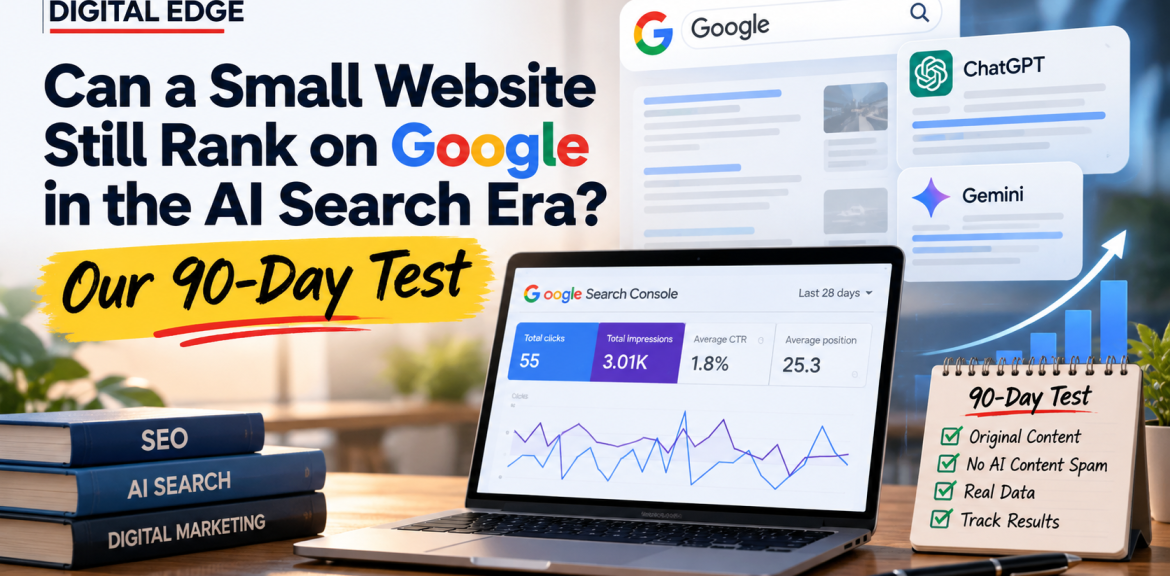
On September 26, 2026, we recorded the website’s Google Search Console performance for the previous 28 days:
- Total organic clicks: 55
- Total search impressions: 3,010
- Average CTR: 1.8%
- Average position: 25.3
The existing visibility is primarily associated with Lanka E-Marketing’s established business and service content rather than the newly relaunched Digital Edge.
That gives the experiment an important starting condition:
We’re not testing whether Google can discover Lanka E-Marketing. We’re testing whether an established small-business domain can build a new informational search audience around a focused publishing project.
Baseline 2: The Digital Edge — New Editorial Footprint
At the beginning of the experiment, the relaunched Digital Edge contains only a small number of newly published research-led articles.
Rather than mixing their performance with established commercial pages, we’ll track the editorial section separately.
During the experiment we’ll monitor:
- impressions earned by Digital Edge articles
- organic clicks to those articles
- new non-branded queries they begin appearing for
- average positions and movement over time
- which topics Google begins associating with the section
- generative and AI-search visibility where measurable
This means the experiment has two questions.
Does the website’s overall organic footprint grow?
And more importantly:
Can The Digital Edge create search visibility that the existing Lanka E-Marketing service pages weren’t already capturing?
We’ll return to the same measurements at Day 30, Day 60 and Day 90.
What Would Count as Progress?
We’re deliberately not setting a promise such as “double traffic in 90 days.”
That would turn an experiment into a marketing claim before we’ve collected the evidence.
Instead, we’ll look for patterns.
Does The Digital Edge begin appearing for a broader set of relevant non-branded queries?
Do individual articles move from being merely indexed to earning meaningful impressions?
Do impressions eventually become clicks?
Do the articles begin earning natural references or links?
Does Google expose them through generative or multimodal search?
Do other AI systems begin finding them?
And, most importantly, does any of that produce useful human behaviour?
The answers may not all move in the same direction.
That’s part of what makes the experiment worth running.
What Would Count as Failure?
This needs to be defined too.
If we publish carefully for 90 days and The Digital Edge gains almost no meaningful Google visibility, we won’t rename the outcome a success because ChatGPT happened to mention one page once.
If impressions grow but qualified engagement doesn’t, we’ll say so.
If AI citations appear but generate no detectable traffic or business value, we’ll separate visibility from outcome.
And if nothing meaningful happens at all, that’s still a result.
A failed experiment reported accurately contributes more than a successful case study whose target was invented after the result.
Why 90 Days?
Ninety days is long enough to observe movement but short enough to keep the experiment disciplined.
It is not a promise that SEO “takes 90 days.”
Google doesn’t give every website a universal ranking timetable, and neither should we.
Some pages may move quickly.
Others may barely move at all.
The 90-day period simply gives us a defined observation window:
- Day 0: establish the baseline
- Day 30: record early movement without declaring victory
- Day 60: examine which pages and queries are developing
- Day 90: compare the outcome with the original baseline and publish what happened
We may continue measuring beyond Day 90, but we won’t quietly move the finish line because the result isn’t convenient.
The Part AI Will Play
It would be dishonest to run an experiment about modern publishing and pretend we don’t use AI.
We do.
AI can help with research direction, question discovery, organizing information, comparing documents, challenging assumptions and editing.
But the editorial responsibility remains human.
Sources still need checking.
Claims still need qualifying.
Experiments still need real data.
And someone still needs to answer the most important question:
Is this worth publishing?
Our objective isn’t to prove that human-written content beats AI-written content.
That distinction is becoming increasingly unhelpful.
We’re testing whether a small publisher can use modern tools without allowing those tools to turn its website into commodity content.
What Happens Next
From this point forward, every major Digital Edge article published during the experiment should have an identifiable contribution.
We’ll record what that contribution is.
We’ll monitor what Google does with the pages.
We’ll watch the newer discovery surfaces without allowing them to distract us from ordinary organic search.
And we’ll return to this experiment with updates.
Not every update needs to be good news.
It just needs to be real.
Final Thought: The Experiment Isn’t Really About AI
AI is what makes this experiment timely.
But it isn’t what makes it important.
The deeper problem is that producing content has become cheaper than producing knowledge.
Anyone can publish more.
The harder question is whether they have anything new to contribute.
For the next 90 days, we’re going to see what happens when a small publisher deliberately chooses the second problem.
Publish less commodity content. Contribute more information. Measure what happens.
Google may reward it.
AI systems may reference it.
Readers may find it useful.
Or the results may be much less impressive than we hope.
We’ll know more in 90 days.
Research & Methodology
This experiment was designed after reviewing Google’s current Search documentation and existing public SEO and AI-search experiments.
Google’s documentation is used to establish what Google publicly confirms. Existing third-party experiments were reviewed to understand what has already been tested and to avoid simply reproducing another AI-visibility case study.
The Digital Edge frameworks and experiment rules described in this article are our own editorial and measurement models. They should not be interpreted as Google ranking systems or Google-provided metrics.
The Day 0 site-wide baseline comes directly from Lanka E-Marketing’s Google Search Console data for the previous 28 days as recorded on September 26, 2026.
Results will be evaluated against the baseline established before the experiment rather than against targets created after observing the outcome.
Primary Sources
- Google Search Central — Spam policies for Google web search
- Google Search Central — Optimizing your website for generative AI features
- Google Search Central — Web multimodal Search performance reporting
- Google Search Central — Latest Search documentation updates


