



For most of the history of search, the mental model was fairly simple.
A person typed a query. Google returned a ranked list of pages. Businesses competed to appear as high as possible in that list.
AI Mode changes that journey.
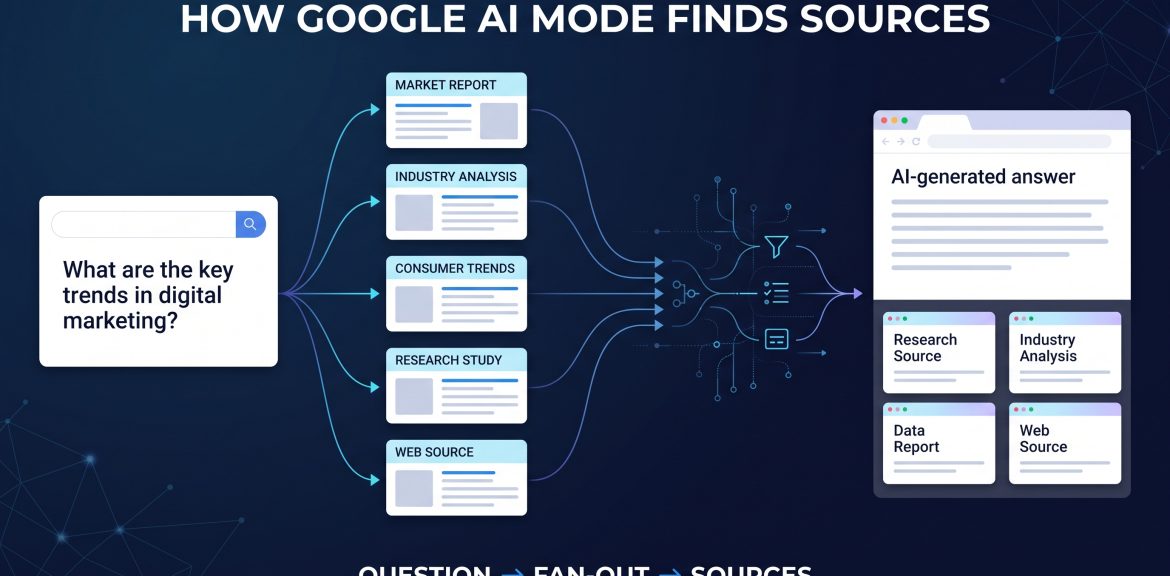
A single question can now trigger multiple related searches behind the scenes. Google can retrieve information from different pages, examine specific information from those pages, combine what it finds into a generated response, and show supporting links alongside that answer.
That creates an important question for anyone working in SEO:
How does a webpage move from simply existing in Google’s index to becoming a source that AI Mode actually uses?
There is no public formula that answers that question completely.
But Google has now revealed enough about retrieval-augmented generation (RAG), query fan-out and its underlying Search systems to separate what we actually know from what the SEO industry is still trying to work out.
And that distinction matters.
The Short Answer: AI Mode Doesn’t Just Run One Search
Google says its generative AI features are rooted in its existing Search ranking and quality systems.
For AI Mode and other generative Search experiences, two concepts are particularly important:
Retrieval-augmented generation (RAG) allows the system to retrieve relevant and current webpages from Google’s Search index and use information from those pages when constructing an answer.
Query fan-out allows the model to generate a set of related searches so it can explore different parts of a question rather than relying only on the exact words the user entered.
A simplified version looks like this:
Question → Query Fan-Out → Retrieval → Selection → Synthesis → Supporting Links
This is useful as a mental model. But it is not a published Google ranking formula.
That distinction will become important throughout this article.
Step 1: One Question Can Become Many Searches
Imagine asking:
“What’s the best way for a small business to improve organic traffic when AI search is reducing traditional clicks?”
Traditional keyword thinking might focus almost entirely on that phrase and closely related variations.
An AI system has a different problem.
To give a useful answer, it may need information about several underlying issues: small-business SEO, AI search visibility, changing click behaviour, content strategy, search demand, measurement and brand visibility.
Google calls the process of generating related searches query fan-out.
Google’s documentation describes it as generating multiple related queries to gather additional relevant information. Google’s own explanation of AI Mode also describes query fan-out as a way to explore subtopics and multiple data sources simultaneously.
Source: Google Search Central — Optimizing your website for generative AI features.
This is a significant change in how we should think about search visibility.
The page that helps answer a question may not necessarily be a page optimized around the exact wording of the original prompt.
It may be discovered because it is highly relevant to one of the underlying information needs.
Step 2: Google’s Search Systems Retrieve Candidate Information
Query expansion alone doesn’t answer the question.
Google still needs information.
This is where retrieval-augmented generation becomes important.
Instead of relying entirely on what an AI model learned during training, RAG allows current external information to be retrieved and used when producing a response.
For Google Search, this has a particularly important implication:
Traditional SEO has not suddenly become irrelevant.
Google says its generative AI features are supported by its core Search systems and can retrieve relevant, up-to-date information from the web.
A page therefore still needs the foundations we already associate with good search visibility:
- It needs to be accessible to Google.
- It needs to be indexable.
- Its content needs to be understandable.
- Its subject needs to be clear.
- It needs to comply with Search policies.
- It needs to provide useful information.
Google also states that pages must be indexed and eligible to appear in Google Search with a snippet to be eligible to appear as supporting links in AI features.
There is no separate secret “AI index” that website owners need to submit their pages to.
Google also says there are no additional technical requirements specifically for appearing in AI Overviews or AI Mode.
Step 3: Retrieval Is Not the Same as Selection
This may be one of the most important distinctions in AI search.
Being retrievable does not mean being selected.
Thousands of webpages may be relevant to a subject.
Only a much smaller group can contribute to a particular generated response or appear among its supporting links.
What Google does not provide is a simple public checklist saying:
Do these seven things and your webpage will be cited.
This is where SEO discussion often moves from documented behaviour into observation, experimentation and speculation.
Those can all be useful.
But they should not be confused with Google’s own claims.
The Digital Edge Evidence Ladder
For AI-search research, we think it is useful to separate claims into four levels.
1. Google Confirmed
Information explicitly described in Google’s documentation, Search Central guidance or official communications.
Examples include:
- AI Mode and AI Overviews can use query fan-out.
- Google’s generative Search features build on existing Search systems.
- Retrieval can bring current web information into generated responses.
- Standard SEO best practices remain relevant.
- There is no special technical requirement solely for appearing in AI Mode or AI Overviews.
2. Independent Evidence
Findings produced through observable experiments, datasets or third-party research.
These findings can reveal patterns, but they do not automatically reveal Google’s underlying algorithm.
For example, researchers can measure how often AI citations overlap with traditional organic rankings.
Those results are useful evidence.
They are not Google specifications.
3. Reasonable Inference
A conclusion that makes sense based on confirmed mechanisms and observed evidence but has not been explicitly confirmed by Google.
This is where careful SEO analysis belongs.
It should be presented as interpretation—not fact.
4. Still Unknown
Questions for which the public evidence simply isn’t sufficient.
This category is more important than it sounds.
Good research isn’t only about explaining what we know. It is also about being clear about what we don’t.
Myth #1: AI Mode Always Runs a Fixed Number of Searches
You may encounter claims that AI Mode performs a particular number of searches for every prompt.
Third-party researchers have observed ranges and patterns in query fan-out behaviour. For example, Ahrefs has published observations from its own research into how AI Mode expands queries.
Source: Ahrefs — What Is Query Fan-Out?.
That is useful industry evidence.
But Google’s public documentation does not specify a universal number of fan-out queries that will be generated for every search.
Google confirms the mechanism. It does not give publishers a universal formula for the number of searches.
Complexity, context and the information required to answer a question can vary dramatically.
Optimizing around an assumed fixed number misses the larger point.
Myth #2: Ranking #1 Means You’ll Be Cited
Traditional rankings still matter because Google’s generative systems are built on Search infrastructure.
But that does not mean the first organic result for the original query must become an AI source.
Query fan-out helps explain why.
A page may become relevant through one of the related searches generated behind the scenes rather than through the user’s original wording.
Third-party research also suggests that AI citations and traditional rankings do not perfectly overlap.
That should not be interpreted as evidence that SEO is dead.
It suggests something more interesting:
AI retrieval can expand the discovery surface beyond the original query.
The practical objective therefore shouldn’t be simply to rank one page #1 for one phrase.
A stronger objective is to become a genuinely useful source within the information space surrounding the user’s problem.
Myth #3: You Need a Special GEO Format for Google
The growth of AI search has created an entire vocabulary around AEO and GEO.
Some of it is useful.
Some of it makes AI visibility sound like an entirely separate discipline requiring special files, artificial writing styles or proprietary formatting.
Google’s current guidance is much less dramatic.
From Google’s perspective, optimizing for its generative AI Search experience remains grounded in SEO fundamentals.
Google says existing SEO best practices continue to be relevant and warns publishers against relying on supposed shortcuts that do not create additional value for users.
This doesn’t mean nothing has changed.
The search experience clearly has.
But there is a major difference between adapting content for a changing information environment and trying to manufacture a format for an imaginary AI ranking checklist.
Make important information easy to understand because it helps readers—not because someone claims an AI requires every paragraph to follow a particular template.
Myth #4: Create a Page for Every Possible Fan-Out Query
Once marketers understand query fan-out, an obvious temptation appears.
Find every possible subquery. Create a page for each one. Capture the whole fan-out.
That can quickly turn into exactly the kind of scaled, low-value publishing Google warns against.
Google’s spam policies define scaled content abuse as generating many pages primarily to manipulate search rankings rather than help users. The policy applies regardless of whether the content is created using generative AI, traditional automation, humans or a combination.
Source: Google Search Central — Scaled content abuse.
The problem isn’t AI itself.
The problem is creating large amounts of unoriginal or low-value content primarily to manipulate visibility.
Query fan-out should help us understand the information a user may need—not become an excuse to manufacture hundreds of pages.
One excellent resource that genuinely resolves several connected questions may be more useful than a collection of near-duplicate pages built around keyword variations.
Myth #5: AI-Written Content Is Automatically a Problem
Google’s position on generative AI content is also more nuanced than many headlines suggest.
Google says generative AI can be useful for research and for adding structure to original content.
The danger appears when automation is used to generate many pages without adding value for users.
Source: Google Search Central — Guidance on using generative AI content.
That distinction is important for publishers.
The meaningful question isn’t simply:
“Was AI involved?”
A better question is:
“What did this page contribute?”
Did it add original analysis?
Did someone verify the claims?
Did it contribute experience, data, evidence or a useful framework?
Did it make an existing subject easier to understand?
Or did it simply reassemble information already available elsewhere?
AI can assist the publishing process.
It cannot substitute for having something worthwhile to publish.
Myth #6: A Citation Automatically Means Traffic
AI-search visibility creates another problem that deserves more attention.
A source can influence an answer without necessarily receiving the click.
A 2026 preregistered field experiment involving 1,100 Google users examined the effects of AI Overviews and AI Mode on publisher traffic. The researchers found that removing these AI features increased click-through to publishers, while an AI Mode-only experience reduced publisher click-through in the experiment.
One study should not be treated as the final word on every Google user or every query.
But it highlights an important distinction:
Citation visibility and referral traffic are not the same metric.
For businesses, the objective cannot stop at:
Did an AI system mention us?
We also need to ask:
Did that visibility create recognition, qualified traffic, engagement, leads, subscribers or revenue?
This is why we don’t believe Cite should be the final stage of an AI-search strategy.
How This Fits the Digital Visibility Stack
In our previous Digital Edge article, SEO vs AEO vs GEO in 2026: What Actually Matters When Search Starts Answering Back?, we introduced a framework for thinking about modern search:
Discover → Retrieve → Select → Cite → Act
AI Mode makes the middle of this stack easier to understand.
Discover
Google needs to know the page exists and understand what it contains.
Retrieve
Search systems need to consider the page relevant to the information requirement.
Select
From the available information, certain sources or passages may become useful for constructing the response.
Cite
Supporting webpages may be surfaced alongside the generated answer.
Act
The user may click, remember the brand, continue researching, subscribe, enquire or take another commercially meaningful action.
This final stage matters.
A citation that produces no useful outcome may still have branding or informational value, but businesses should avoid treating citation counts as the only definition of success.
What Should Website Owners Actually Do?
The practical implications are less exotic than much of the GEO industry makes them sound.
Build Technically Sound Pages
If Google cannot properly access, index and understand your content, sophisticated AI-search tactics won’t rescue it.
Technical SEO remains the foundation.
Publish Information Worth Retrieving
Don’t begin with:
How can we make AI cite this?
Begin with:
What information can we provide that deserves to become a source?
That might mean original research, first-party data, expert analysis, practical experience, an experiment, a useful comparison or a clearer framework for understanding a complicated subject.
Cover the Problem, Not Every Keyword Variation
Query fan-out should push content strategy toward a better understanding of user intent.
It should not push publishers toward mass-producing near-identical pages.
Make Claims Verifiable
Where possible, link to primary evidence.
Distinguish documented facts from interpretation.
If the evidence is uncertain, say so.
Trust is difficult to build when an article presents every industry theory with the same level of certainty.
Use Meaningful Images and Video
Google’s current guidance encourages publishers to support textual information with useful, high-quality images and video where appropriate.
A diagram that genuinely explains a process can therefore do more than decorate an article.
For this article, the relationship between fan-out, retrieval, selection and citation is easier to understand visually than through paragraphs alone.
Measure Outcomes Beyond Rankings
Google now provides a dedicated Generative AI performance report in Search Console, giving publishers additional visibility into how their content performs across Google’s generative AI features in Search and Discover.
Source: Google Search Central — Optimizing your website for generative AI features.
That gives publishers another measurement layer.
But impressions still aren’t the final business objective.
We should ultimately connect:
Visibility → Engagement → Trust → Action
What Google Still Hasn’t Told Us
Despite the growing amount of official documentation, several important questions remain unresolved publicly.
Google has not given publishers a universal formula describing exactly why one eligible source is selected over another for every AI Mode response.
It has not published a guaranteed citation checklist.
It has not said that one particular content length, paragraph structure or schema type will cause a page to be cited.
It has not established a universal fixed number of fan-out searches per query.
And it does not guarantee that a technically compliant, high-quality page will be retrieved or shown.
That uncertainty isn’t a weakness in SEO analysis.
It is part of the reality we need to measure.
This is also why independent experiments matter.
From SEO Theory to an Actual Experiment
This article explains what we currently know about the machinery.
The more interesting question comes next:
Can a relatively small website deliberately create source-worthy information and earn measurable visibility inside AI search?
Rather than answering that question with another list of recommendations, The Digital Edge intends to test it.
We will start with a defined group of topics, publish content designed around original information and clear sourcing, establish baseline visibility, and monitor what changes over time.
Where reliable data is available, we will separate:
- traditional organic visibility
- generative Search visibility
- citations or supporting-link appearances
- referral traffic
- engagement
- meaningful actions
If the experiment works, we’ll show what happened.
If it doesn’t, that result will be useful too.
Because the objective isn’t to prove that GEO works. The objective is to find out what actually happens.
Final Thought: Citation Is Not the Finish Line
AI Mode changes the search journey, but it doesn’t erase the fundamentals of search.
Google still needs to discover useful information.
Its systems still need to retrieve it.
From the available information, sources need to be selected.
Some may support a generated response.
And after all of that, there is still a human being on the other side deciding what to trust and what to do next.
That is why our model remains:
Discover → Retrieve → Select → Cite → Act
For years, SEO concentrated heavily on the first part of that journey.
AI search forces us to think about the whole thing.
The opportunity isn’t simply to become another page optimized for an AI citation.
It is to become a source worth retrieving in the first place.
Research & Methodology
This article was developed by comparing Google’s current Search Central documentation on generative AI features, AI-search optimization, Search Essentials, AI-generated content and spam policies with independent 2026 research into query fan-out, citations and user click behaviour.
Claims described as Google-confirmed are based on Google’s own published documentation. Third-party observations are treated as independent evidence rather than descriptions of Google’s internal algorithm.
Where Google has not publicly disclosed a mechanism or fixed rule, this article deliberately identifies that uncertainty rather than presenting an assumption as fact.
Primary Sources
- Google Search Central — Optimizing your website for generative AI features
- Google Search Central — AI features and your website
- Google Search Central — Guidance on using generative AI content
- Google Search Central — Spam policies for Google web search
- Google Search Central — Google Search Essentials


