





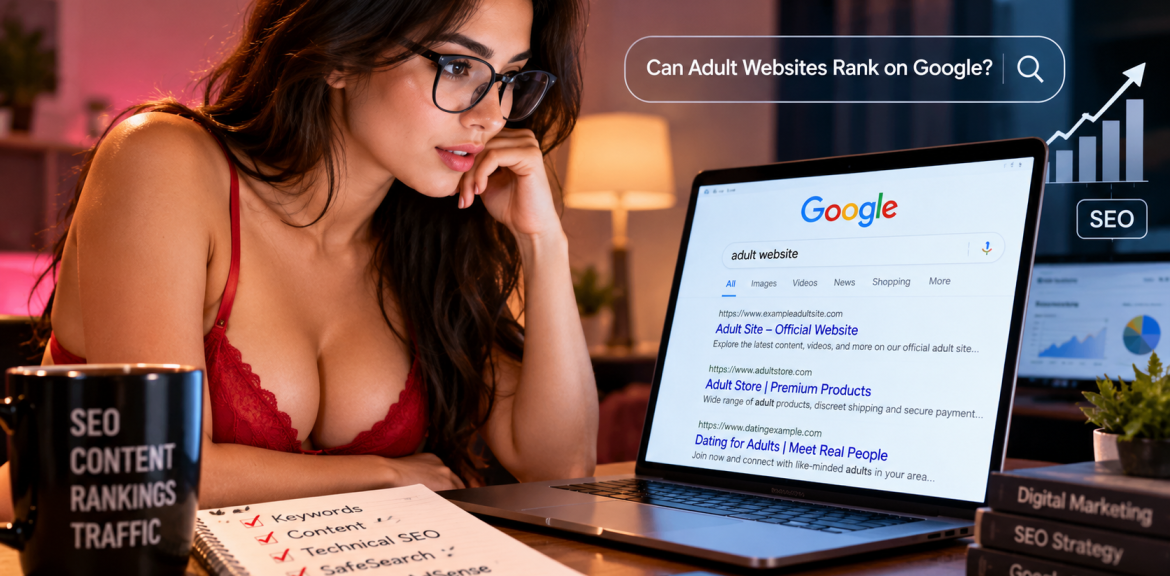

Quick answer: Yes, adult-oriented websites can appear in Google Search. Google does not impose a blanket organic-search ban merely because a website serves an adult audience. However, SafeSearch can filter explicit results, age-verification barriers can prevent Googlebot from accessing pages, and Google Ads and AdSense have separate advertising policies. Ranking, advertising eligibility and monetization are three different questions.
For owners of dating platforms, age-restricted online stores and other legitimate adult-oriented businesses, this guide explains how to approach SEO responsibly without confusing search visibility with permission to run or display ads.
Can adult websites rank on Google in 2026?
Yes. Google Search evaluates relevance and quality while using additional systems to reduce unexpected exposure to explicit material. Google’s guidelines for sites with explicit content explain how SafeSearch, content classification, crawl access and site organization affect visibility. An adult-oriented site can be indexed and appear for relevant queries, but that does not mean every user will see it.
The term adult website covers very different businesses. A general dating service, a retailer selling age-restricted merchandise and a site hosting explicit media should not be treated as if they have identical SEO or advertising requirements.
Organic Search, SafeSearch, Google Ads and AdSense: four separate systems
| System | What it controls | What site owners should check |
|---|---|---|
| Google organic Search | Whether pages can be discovered, indexed and ranked for relevant searches | Crawl access, indexability, page usefulness, query intent and technical SEO |
| SafeSearch | Filtering of explicit results based on user settings and Google’s classification | Explicit content signals, imagery, links and separation of non-explicit pages |
| Google Ads | Whether a business may purchase ads and under what restrictions | Advertiser certification, landing pages, geography and applicable advertising policies |
| Google AdSense | Whether a publisher may display Google-served ads on particular content | Publisher policies, restricted content, ad demand and page context |
Practical example: A dating platform may have pages indexed in organic Search but still require Google Ads certification to advertise. An educational article discussing advertising policy may be appropriate for a professional marketing blog, yet Google still assesses the actual page context for publisher monetization.
How does Google SafeSearch affect adult website SEO?
SafeSearch is designed to help users filter explicit material. Google’s systems evaluate text, images, video and links—not simply whether a domain contains an adult-related word. A website that mixes non-explicit guides with explicit material may find that some pages, or potentially more of the site, are filtered for users with SafeSearch enabled.
What can site owners do?
- Organize content clearly. If a site hosts substantial explicit and non-explicit content, Google recommends grouping explicit pages on a separate domain or subdomain.
- Label genuinely explicit pages accurately. Google documents an
<meta name="rating" content="adult">tag for explicit pages. Do not place this tag indiscriminately on non-explicit educational pages. - Review imagery, ads and outgoing links. SafeSearch classification can consider more than the main text.
- Do not try to mislabel explicit content. The goal is accurate classification, not evasion of filtering.
See Google’s official SafeSearch and explicit-content guidance.
Can an age-verification screen prevent Google from indexing a website?
Yes, it can create a crawlability problem. If Googlebot sees only an age gate instead of the page content, Google may be unable to understand or rank the page effectively. Google recommends allowing verified Googlebot requests to access the content without being blocked by the age gate. This is a technical crawler-access recommendation—not permission to ignore legal age-verification obligations for human visitors.
Before changing access rules, have your developer verify legitimate Googlebot requests and assess local compliance requirements. Do not broadly remove age checks or expose protected material to everyone just to improve rankings.
How to improve SEO for a legitimate adult-oriented website: a practical checklist
1. Match business-intent search queries
Build pages around what potential customers or business buyers genuinely need: service explanations, location availability, delivery policies, pricing clarity, account safety, privacy policies and useful product or platform information. Avoid mass-producing nearly identical location or keyword pages without unique value.
2. Create trustworthy business information
Publish clear contact details, company information, terms, privacy and refund policies where applicable. For platforms involving user profiles or user-generated content, document moderation, reporting and safety processes. These elements support user confidence; they are not a shortcut to guaranteed rankings.
3. Make important pages crawlable and indexable
Check robots.txt, canonical tags, accidental noindex directives, server errors, redirects and XML sitemaps. Inspect representative URLs in Google Search Console. Ensure mobile users and search crawlers can access the intended page content.
4. Use descriptive titles and useful page content
Write titles that describe each page accurately. Answer customer questions directly, include unique product or service details, and avoid stuffing repetitive keywords such as “adult website SEO†into every heading.
5. Strengthen internal links
Connect relevant category pages, product or service pages, FAQs and educational resources. A logical site structure helps users navigate and helps search engines discover important URLs.
6. Handle age-restricted products correctly
For applicable Google Shopping features, Google advises using the adult feed attribute or hasAdultConsideration structured data for adult-oriented products. Google says this labeling does not itself affect organic web-search visibility. Merchant Center eligibility is a separate issue from organic SEO.
7. Earn relevant links rather than buying authority
Seek legitimate editorial mentions, business references and useful industry resources. Avoid paid link schemes, irrelevant directory blasts and artificial link networks.
8. Measure the right outcomes
Track organic clicks, impressions, query groups, indexed pages and qualified conversions in Search Console and your analytics platform. Segment results by country and landing page. A page that attracts many irrelevant visits may deliver less business value than one attracting a smaller, qualified audience.
Why is my adult-oriented website indexed but not getting Google traffic?
| Possible issue | How to investigate | Reasonable next step |
|---|---|---|
| SafeSearch filtering | Review Google’s explicit-content guidance and whether pages are classified as explicit | Improve accurate labeling and separate clearly different content types |
| Age gate blocks crawlers | Use URL Inspection and server logs to see what verified Googlebot can fetch | Implement compliant crawler access with technical and legal review |
| Low search relevance | Compare landing-page content with actual Search Console queries | Rewrite pages to answer the intended business question |
| Thin or duplicated pages | Audit template pages, canonicals and overlapping keywords | Consolidate or materially improve low-value pages |
| Technical indexing issue | Check robots, noindex, HTTP status, canonical and sitemap | Fix the specific issue before requesting recrawling |
| Weak conversion path | Review landing-page usability and qualified enquiries | Clarify services, trust information and next steps |
Indexing does not guarantee impressions, and impressions do not guarantee clicks. For a broader diagnostic process, see our guide to why a website is not showing on Google.
Can adult or dating businesses run Google Ads?
Some can, under specific conditions. Google’s Dating and Companionship advertising policy allows certain qualifying dating services if they meet its rules and obtain the required certification. Restrictions can depend on category, user age, country, local law and other signals. Some compensated companionship services and deceptive dating practices are prohibited.
Important geographic detail: Google’s published dating-ad policy currently lists Sri Lanka among locations where dating and companionship ads are not eligible to serve. That is a restriction on where those ads serve; it does not mean every Sri Lankan agency is automatically barred from providing lawful SEO advice to international businesses.
Other adult-related products and services may fall under different sexual-content advertising rules. Never assume that permission to appear in organic Search also grants permission to advertise.
Can adult-related articles or websites earn money from AdSense?
It depends on the actual content. Google Publisher Policies prohibit sexually explicit content, including graphic sexual text and imagery. Separate Publisher Restrictions cover various sexual-content categories and may lead to reduced advertising demand. Google’s policy materials also distinguish some educational discussions from promotional or arousing content.
For a digital marketing publication, a neutral article explaining Google’s policies is materially different from a page displaying explicit material or promoting sexual products. However, no publisher can guarantee unrestricted ad serving based on educational intent alone. Review the page, its imagery, outbound links and any policy-center notices.
Official references: sexually explicit content policy, sexual-content restrictions, and publisher restrictions overview.
A 30-minute SEO review for site owners
- Minutes 0–5: Identify your most valuable business-intent search queries and landing pages.
- Minutes 5–10: Inspect three representative URLs in Google Search Console.
- Minutes 10–15: Check whether age gates, login walls or security settings block verified Googlebot.
- Minutes 15–20: Review whether explicit and non-explicit pages are clearly separated and accurately described.
- Minutes 20–25: Check titles, internal links, useful page details and mobile usability.
- Minutes 25–30: Review applicable Google Ads, Merchant Center and AdSense policies before planning monetization.
Use the findings to prioritize fixes. Do not assume that a single tag, plugin or schema type can overcome SafeSearch filtering or advertising restrictions.
Frequently asked questions
Does Google ban all adult websites from search results?
No. Google documents how sites with explicit content can appear in Search, although SafeSearch and other systems may limit visibility for particular users and queries.
Does SafeSearch mean my website has a Google penalty?
No. SafeSearch filtering is not the same as a manual action or spam penalty. Check classification, crawlability and Search Console information before diagnosing the cause.
Can a dating website rank without running Google Ads?
Yes. Organic SEO does not require a paid Google Ads campaign. Advertising eligibility is governed by separate policies.
Should I add an adult rating meta tag to every page?
No. Google’s guidance describes marking pages that are genuinely explicit. Apply classifications accurately rather than labeling ordinary educational pages as explicit.
Can Google crawl content behind an age-verification screen?
It depends on the implementation. Google recommends permitting verified Googlebot access without triggering the age gate while site owners continue to meet applicable legal requirements for visitors.
Will an educational article about adult-industry SEO be eligible for AdSense?
It may be, depending on the page’s actual content and Google’s review. Educational framing does not guarantee unrestricted monetization; publisher policies and restrictions still apply.
What should I measure after publishing an adult-industry SEO guide?
Measure relevant organic queries, clicks, landing-page engagement, qualified business enquiries and AdSense policy or revenue signals. Avoid treating raw traffic as the only measure of success.
Final takeaway
Adult-oriented businesses can pursue legitimate organic SEO, but they must account for SafeSearch classification, crawler access, content quality, applicable law and separate advertising rules. For marketers, the most sustainable approach is to answer real business questions accurately—not chase explicit search traffic that is unrelated to the service being offered.
Explore related guides from The Digital Edge: Why Is My Website Not Showing on Google? and Google AI Overviews and Website Traffic (verify the second URL is published before linking).


