


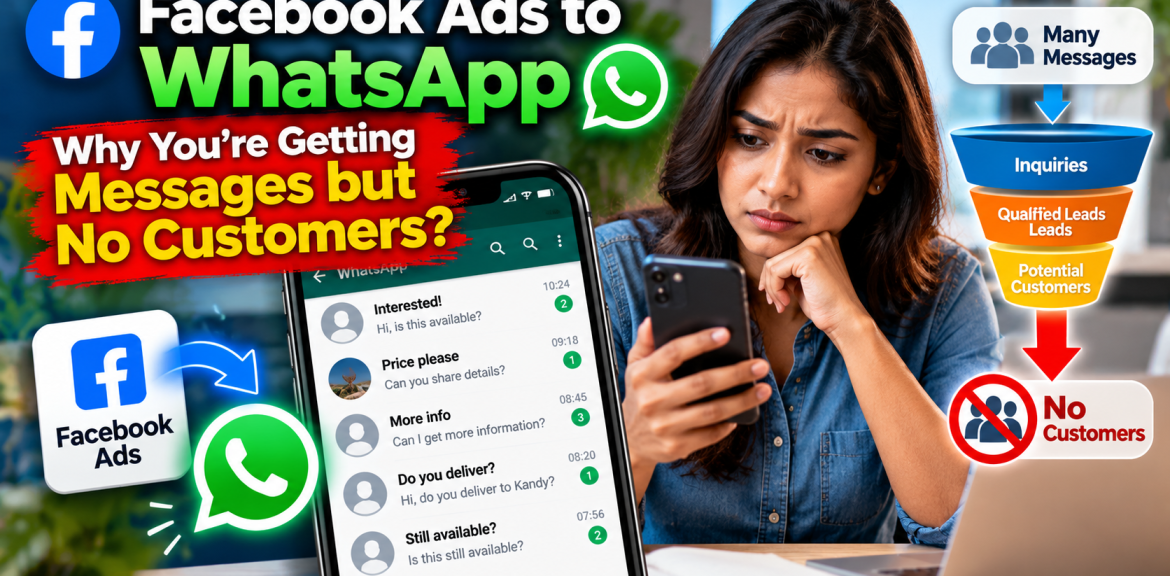

Getting WhatsApp messages from Facebook ads but no sales? The problem is often not the number of messages. It is the gap between someone starting a conversation and becoming a qualified prospect who is ready, able and willing to buy. Check your campaign objective, the promise in your ad, how you qualify inquiries, response speed and whether you track sales—not just chats.
This guide is for small-business owners, course providers, service companies and marketers running Facebook or Instagram ads that open WhatsApp. It explains how to diagnose the problem without assuming every low-quality inquiry is a fake lead.
Why Facebook Ads Generate WhatsApp Messages but Not Customers
Click-to-WhatsApp ads reduce friction: a person taps the ad and starts a chat. But a chat is an early action, not proof of buying intent. Someone might be comparing prices, checking eligibility, asking for a future date or simply curious. Others may be interested but unable to purchase immediately.
Meta describes ads that click to WhatsApp as a way to start conversations from Facebook and Instagram. Its business guidance also distinguishes optimizing for conversations from optimizing for downstream outcomes such as leads and purchases. Source: WhatsApp for Business.
First, Identify Where Your Leads Are Being Lost
| What you see | Possible explanation | What to check first |
|---|---|---|
| Many chats; most ask only “Price?†| Ad creates curiosity without setting expectations | Show a starting price or price range where appropriate |
| Lots of people outside your service area | Geographic or delivery expectations are unclear | Review targeting, location wording and service coverage |
| People ask for a service you do not provide | Creative or ad copy is ambiguous | Rewrite the offer and list what is included |
| Interested prospects stop replying | Slow, confusing or overly long follow-up | Audit response times and first replies |
| Qualified inquiries but few sales | Price, trust, timing, availability or sales-process issues | Review objections and handoff to sales staff |
| Sales happen but Ads Manager looks weak | Offline conversions are not recorded | Track actual outcomes in a CRM or lead sheet |
Key distinction: A low-quality lead is not necessarily a fake lead. Do not accuse Meta or your audience of generating fake inquiries without evidence.
1. Choose a Campaign Goal That Matches the Business Outcome
If the platform is optimizing for people likely to start conversations, you may receive chats that never become qualified leads. Where available and appropriate, test lead-oriented optimization and feed back quality outcomes rather than judging success by message count alone.
Meta reports that, in a November 2024 experiment involving 116,000 campaigns across 43,000 businesses, click-to-WhatsApp campaigns optimized for leads had a 24% lower average cost per lead than campaigns optimized for conversations. This is a study average, not a promise for your campaign. Meta also notes regional availability restrictions; its published setup guidance says this option is not available in the EU, UK, Japan or South Korea. Interface options and eligibility may change. Source: WhatsApp for Business lead-generation guidance.
Before changing objectives, confirm what is available in your own Ads Manager account and whether you can measure qualified leads reliably.
2. Make Your Ad Qualify People Before They Message
An ad should not simply say “Message us now.†It should answer enough questions for people to decide whether the offer fits.
- Who it is for: Identify the customer, industry, age group or eligibility criteria when relevant and permitted.
- What is offered: State the actual product, course, appointment or service.
- Where: Explain the service area, delivery location or whether the service is online.
- Price expectation: Give a transparent starting price or range when useful; avoid misleading “free†wording.
- Next step: Explain what happens after they message, such as receiving a brochure, quote or callback.
Example for a training course: “Weekend professional course in Colombo | Next intake: [confirmed date] | Fee: [confirmed amount] | Entry requirements: [verified criteria]. Message us for the syllabus and registration details.†Replace the bracketed information with accurate details; never invent dates or fees.
3. Improve the First WhatsApp Reply
The first reply should be friendly, short and useful. An immediate wall of text can make a prospect disengage; an unexplained “Call this number†can create unnecessary friction.
Example: Service business
Hi! Thanks for contacting us about [service]. We can help you check the best option. Could you tell us your location and what you need? We’ll then share the relevant price and next steps.
Example: Course registration
Hi! Thanks for your interest in [course]. The next confirmed intake is [date], and the fee is [amount]. Are you looking to join this intake or a later one? I can share the entry requirements and registration process.
Use approved WhatsApp messaging tools and respect consent, privacy and applicable platform policies. Avoid repeatedly chasing someone who has asked not to be contacted.
4. Ask Two or Three Useful Qualification Questions
Qualification helps your team distinguish an immediate opportunity from someone researching for later. Ask only questions needed to help the person, and avoid collecting sensitive personal information unnecessarily.
- Fit: “Which product or service are you interested in?â€
- Timing: “When would you like to start?â€
- Location or requirements: “Which city are you in?†or “Do you meet the stated entry requirements?â€
Do not use a long questionnaire as a barrier. The purpose is to make the conversation more useful, not to interrogate the customer.
5. Track the Whole Funnel, Not Just Cost per Message
Here is a simple example using illustrative numbers only, not a real campaign result:
| Metric | Illustrative result | What it tells you |
|---|---|---|
| Ad spend | $200 | Marketing investment |
| WhatsApp conversations | 100 | Cost per conversation = $2 |
| Qualified leads | 25 | Qualification rate = 25% |
| Paying customers | 5 | Lead-to-customer conversion = 20% |
| Cost per customer | $40 | $200 ÷ 5 customers |
A campaign with fewer chats can be more profitable if those chats produce more customers. Compare cost per qualified lead, cost per customer and revenue or margin—not just cost per conversation.
A simple lead-quality scorecard
| Signal | Score |
|---|---|
| Matches service area and stated requirements | 0–2 |
| Clearly needs the product or service | 0–2 |
| Has a realistic purchase or enrollment timeframe | 0–2 |
| Understands the published price or budget range | 0–2 |
| Agrees to a practical next step | 0–2 |
Use this as an internal triage tool, not as an official Meta scoring system. Scores of 8–10 may indicate a high-priority follow-up, 5–7 a nurture opportunity and 0–4 an inquiry that needs clarification. Adapt the categories to your business and avoid discriminatory criteria.
6. Fix the Follow-Up Process Before Increasing the Budget
When prospects are ready but nobody responds, spending more on advertising may simply create more missed opportunities. Assign an owner for every new inquiry, use a shared tracking sheet or CRM, and define when a lead should be handed to a salesperson.
Record the ad or campaign, date, service requested, response time, qualification status, next action and final outcome. Avoid storing unnecessary sensitive details. Review lost inquiries by reason: price, timing, eligibility, unavailable service, no response or competitor selection.
Meta’s small-business guidance recommends clear ad creative, an accurate business profile and prompt replies. Source: WhatsApp for Business small-business guide.
7. Run a Seven-Day WhatsApp Lead Quality Audit
- Day 1: Export or record your recent inquiries and classify their outcomes.
- Day 2: Review ad copy, creative, location and offer for ambiguity.
- Day 3: Compare conversation-focused and lead-focused settings available to your account.
- Day 4: Improve your greeting, qualification questions and sales handoff.
- Day 5: Test one creative or offer change while keeping other variables stable.
- Day 6: Review the actual objections and unanswered conversations.
- Day 7: Compare qualified-lead rate and customer outcomes, noting that seven days may be too short for reliable conclusions in low-volume or long-sales-cycle businesses.
When Should You Pause or Change an Ad?
Do not pause a campaign simply because the first few messages were weak. Check whether you have enough data to identify a consistent pattern. If the ad repeatedly attracts people who misunderstand the offer, fix the message. If qualified leads are coming in but sales are not closing, examine the offer and sales process before changing targeting.
Decision rule: If inquiry quality is poor, improve qualification and creative. If inquiry quality is good but sales are poor, improve the conversion process. If customers are buying but your reporting is incomplete, fix measurement.
Frequently Asked Questions
Why do I get many WhatsApp messages but no sales from Facebook ads?
Common reasons include broad or unclear ad messaging, mismatched customer expectations, weak lead qualification, slow follow-up, pricing objections and poor conversion tracking. Review the complete path from ad click to purchase.
Are WhatsApp inquiries from Facebook ads fake?
Not necessarily. Some people are curious, comparing options or not ready to buy. Investigate suspicious patterns before concluding that messages are fake.
Should I optimize Facebook ads for messages or leads?
Choose based on your objective and available measurement. If your account supports lead optimization and you can identify qualified leads, it may be worth testing. Availability and results differ by region and account.
How do I reduce irrelevant WhatsApp messages?
State the offer, location, eligibility, price expectations and next step clearly in your ad. Review targeting and use a brief, helpful qualification flow.
What is a good cost per WhatsApp lead?
There is no universal benchmark. It depends on industry, market, product value and how many conversations become qualified leads or customers. Calculate your own sustainable cost from conversion rate and profit margin.
Can I measure actual sales from WhatsApp ads?
Yes, with a reliable process for recording leads and sales. Depending on your setup and eligibility, CRM integrations, Meta’s Conversions API or offline measurement options may help connect downstream outcomes to campaigns. Confirm current availability and privacy requirements.
The Bottom Line
More WhatsApp messages do not automatically mean more customers. The strongest campaigns align ad expectations, lead qualification, fast and helpful responses, and real business outcomes. Measure the entire funnel, make one improvement at a time and invest more only when you understand what is working.
For related reading, explore our WordPress security guide and our Google indexing troubleshooting guide. These cover other practical ways to protect and improve your digital presence.
Sources and Editorial Note
- WhatsApp for Business: Ads That Click to WhatsApp
- WhatsApp for Business: Lead Generation Strategies
- WhatsApp for Business: Down-Funnel Optimization
- Google Search Central: Helpful, Reliable, People-First Content
Editorial note: This guide combines published platform guidance with practical campaign-diagnostic recommendations. Example messages, funnel figures and scoring thresholds are illustrative, not verified results from a particular client campaign. Platform features and availability may change. Last reviewed: October 2026.


