


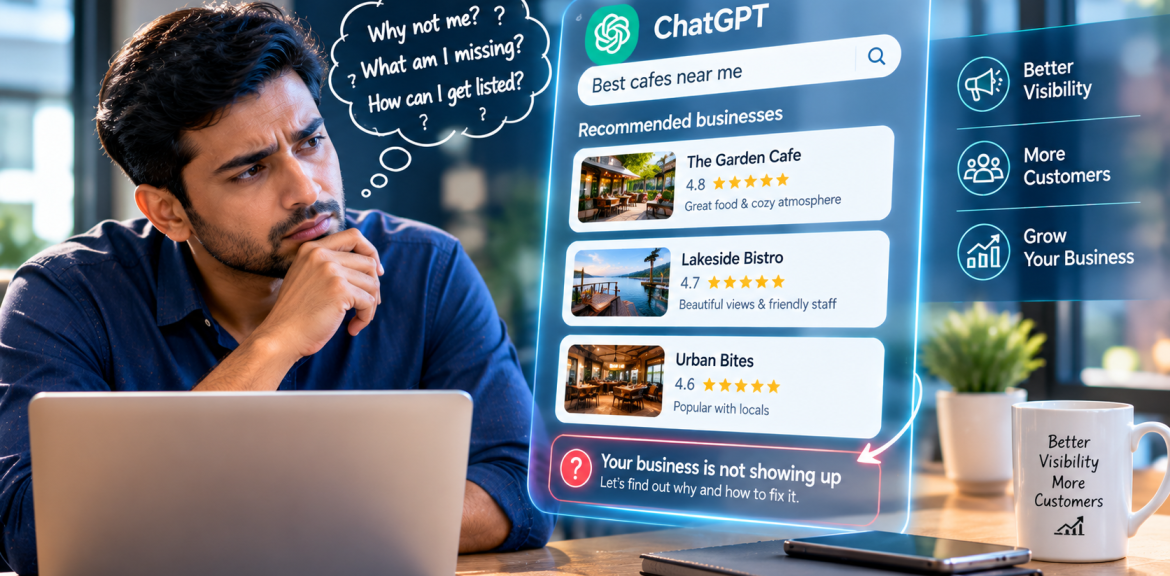

Why doesn’t ChatGPT recommend your business? The short answer is that AI assistants do not maintain a guaranteed directory where every legitimate company appears. A business may be missing from an answer because the assistant has insufficient reliable information, cannot access its website, interprets the question differently, or finds other sources more relevant. And sometimes the assistant simply chooses not to name any businesses.
That is frustrating when your competitors appear in an answer and you do not. But before you pay someone to “register your business with AI,†separate three questions: Can an AI search system find your website? Can it understand what you do? And does independent evidence support recommending you for a specific customer need? Each requires a different response.
This practical guide explains how ChatGPT search visibility works, what business owners can control, and how to run a useful 30-minute audit without chasing unproven AI-ranking tricks.
Can you make ChatGPT recommend your business?
You can improve your business’s discoverability and the clarity of its public information, but you cannot force ChatGPT to recommend it. OpenAI says public websites can appear in ChatGPT search and recommends allowing its search crawler, OAI-SearchBot, to access relevant pages. Search placement is not guaranteed. That is an eligibility and accessibility consideration—not a promise of a citation, endorsement, or sales lead.
Also, “ChatGPT†is not a single fixed results page. An answer can differ depending on whether the assistant uses live search, the user’s exact question, location context, available sources, and the time of the query. A screenshot showing a competitor mentioned once is not a reliable ranking report.
Four different outcomes that marketers often confuse
| Outcome | What it means | What to measure |
|---|---|---|
| Discoverable | Public pages can potentially be accessed by a search system. | Crawler access, indexability, accessible page content. |
| Referenced | An AI response links to or cites your page as a source. | Documented citation tests, referral visits. |
| Recommended | The answer names your company as a potentially suitable provider. | Repeatable, qualified prompt tests—not one screenshot. |
| Converted | A visitor contacts, books or purchases from you. | Qualified enquiries, leads and sales in analytics/CRM. |
A website can be discoverable without being cited, cited without being recommended, and recommended without producing a customer. This distinction is essential when assessing any agency’s claims about “AI rankings.â€
Why ChatGPT may not mention your business: eight checks
1. Your website does not clearly say what you offer
Imagine a visitor asking, “Which companies build WooCommerce websites for small Australian retailers?†If your homepage says only “We transform digital experiences,†it gives the visitor—and search systems—less concrete information than a page that describes WooCommerce development, supported markets, services, limitations and real examples.
Fix: Write plain-language service pages explaining what you do, who you help, where you operate, and how customers can engage you. Avoid repeating a list of cities or services you do not genuinely serve.
2. OAI-SearchBot is blocked
OpenAI identifies OAI-SearchBot as the crawler relevant to surfacing public website content in ChatGPT search. Check your robots.txt, CDN, web application firewall and security plugins. A site can permit Googlebot while blocking other bots, or return an unexpected 403 or 429 response.
Fix: Review the official OpenAI crawler documentation and publisher FAQ. Allow OAI-SearchBot where you want public search discovery. Do not indiscriminately disable security protections.
OAI-SearchBot and GPTBot have different purposes. Allowing a search crawler does not require allowing a training crawler. Review each crawler’s official documentation before changing rules.3. Your important pages are hidden behind scripts, logins or broken redirects
If a service description only appears after a user logs in, clicks a complicated interface, or waits for client-side code to load, some crawlers may struggle to retrieve the useful text. A homepage that works for you does not prove every service URL works for a bot.
Fix: Test the exact page URL, redirects, HTTP status, page title and visible HTML. Ensure essential service descriptions and contact details are accessible without a login.
4. Your company information contradicts itself
One page says you serve the UK; another says your business operates only in Sri Lanka. Your contact page shows an old phone number. A directory lists a previous company name. Inconsistent facts make it harder for customers—and information retrieval systems—to understand your business confidently.
Fix: Align the business name, service areas, contact details and service descriptions across your website and legitimate third-party profiles. For local businesses, keep your Google Business Profile accurate.
5. You have little verifiable evidence of your work
“We are the best SEO company†is a claim, not evidence. An informative portfolio entry showing the type of project, what was implemented and a verifiable result is more useful to a prospective customer. If a result is confidential, describe the methodology without inventing numbers.
Fix: Publish real project examples, author information, service processes, transparent policies and genuine customer testimonials where permission is granted. Do not fabricate reviews or claim AI endorsements.
6. Your site answers broad questions but not buying questions
A blog post titled “What is SEO?†may help a beginner, but it may not answer “Who can migrate my WordPress website and maintain it monthly?†For business discovery, service-specific and comparison-friendly information matters.
Fix: Build pages around genuine customer needs: deliverables, platform compatibility, project process, typical timelines, support scope, regions served and contact options. Avoid fake price ranges or guarantees.
7. Your business has limited independent corroboration
Independent coverage, professional memberships, legitimate industry directories, partnerships and authentic reviews can help people verify who you are. These are not guaranteed AI ranking factors, but they provide useful evidence beyond your own marketing copy.
Fix: Earn relevant mentions through real work and relationships. Do not buy fabricated citations, mass-post identical directory entries or create fake discussion threads.
8. The question does not actually match your business
A company specializing in WordPress development may not appear when someone asks for enterprise mobile-app engineers. This is not necessarily a visibility failure. Sometimes competitors are more relevant to that exact question.
Fix: Test realistic prompts that describe your actual services, market and customer type. Assess whether the recommendation would genuinely help the person asking.
The 30-minute ChatGPT business visibility audit
| Time | Action | Record |
|---|---|---|
| 0–5 min | Open your main service pages in a private browser window; confirm they load without login. | URLs, status codes, missing content. |
| 5–10 min | Review robots.txt and firewall rules for OAI-SearchBot. | Allowed, blocked or needs technical review. |
| 10–15 min | Read your homepage as a new customer: does it state service, audience and location? | Missing or vague information. |
| 15–20 min | Check business identity across website and relevant public profiles. | Conflicting facts to correct. |
| 20–25 min | Test three realistic customer questions using ChatGPT search; note whether sources are shown. | Date, exact prompt, response, citations. |
| 25–30 min | Review analytics for referral visits and set a baseline for qualified enquiries. | Sessions, conversions, limitations. |
Do not treat this as a pass/fail certification. It is a repeatable baseline that helps identify specific improvements. Use consistent prompts and test conditions when checking again, and remember that AI responses are variable.
A practical example: vague agency page versus useful agency page
Illustrative example—not a claim about a real company or a controlled AI-ranking experiment.
| Vague page copy | More useful page copy |
|---|---|
| “We deliver next-generation digital transformation solutions worldwide.†| “We build and maintain WordPress and WooCommerce websites for small businesses, including migration, plugin maintenance, technical SEO and ongoing support. Our team is based in Sri Lanka and works remotely with international clients.†|
The second version gives a person specific facts to evaluate. It does not guarantee that ChatGPT will recommend the agency, but it better answers the questions a prospective customer would naturally ask.
Should you add schema markup or an llms.txt file?
Use valid Organization or LocalBusiness structured data where appropriate, ensuring it matches visible information. It can help describe entities to systems that support the markup, but there is no universal schema switch that guarantees ChatGPT recommendations.
Likewise, an llms.txt file is not an official requirement for ChatGPT search inclusion. Do not spend more time on speculative files than on crawlability, useful service pages and real evidence.
How is ChatGPT visibility different from Google AI Overviews?
ChatGPT search and Google’s AI Overviews are different products with different discovery systems. OpenAI publishes guidance for OAI-SearchBot; Google says supporting links in AI Overviews and AI Mode must meet ordinary Search eligibility requirements and be indexed with snippet eligibility. Neither offers guaranteed placement. See Google’s AI features guidance.
If your Google organic traffic has dropped, diagnose that separately rather than assuming ChatGPT caused it. Our guide on sudden Google traffic declines explains how to distinguish rankings, demand and measurement changes. For Google indexing issues, see Discovered – Currently Not Indexed. Editorial note: verify both internal URLs against the live published slugs.
How to measure whether AI search is bringing customers
OpenAI’s publisher FAQ says ChatGPT search referral links can include utm_source=chatgpt.com. Check your analytics for referrals and tagged sessions, but expect attribution gaps: a customer may see your company in an AI answer and later search your brand directly, call you or visit from another device.
Track three layers: visibility observations (repeatable prompts and citations), website engagement (referral visits and useful actions), and commercial outcomes (qualified enquiries and customers). Do not invent an “AI ranking position†from a single answer.
A simple monthly tracking sheet
| Measure | How to record it | What it cannot prove |
|---|---|---|
| Brand mentions | Same five customer-intent prompts, date and search settings. | A universal ranking across all users. |
| Citations | Exact linked URL and question. | That every user sees the same citation. |
| Referrals | Analytics source/medium and ChatGPT UTM traffic. | All assisted brand discovery. |
| Enquiries | Ask leads how they found you; note CRM source. | Perfect attribution. |
What to do in the next 30 days
- Week 1: Fix access errors and inconsistent business facts. Confirm important public service pages are readable.
- Week 2: Improve two service pages with specific deliverables, audiences, regions served, FAQs and clear contact routes.
- Week 3: Add one real, permission-approved case study or helpful implementation example. Seek genuine industry references rather than artificial links.
- Week 4: Re-run your baseline prompts, review referral data and qualified leads, and document what changed. Avoid attributing every difference to your edits.
The goal is not to “trick ChatGPT into choosing you.†It is to make your business easier for customers and search systems to find, understand and verify.
Frequently asked questions
Is there a form to submit my business to ChatGPT?
There is no universal submission form that guarantees a business recommendation. OpenAI’s public guidance focuses on making website content accessible to ChatGPT search, including allowing OAI-SearchBot.
Why does ChatGPT recommend competitors but not my company?
Possible reasons include the relevance of the question, accessible public information, source availability and the variability of generated answers. A competitor mention does not establish a permanent ranking or prove your site is penalized.
Does allowing OAI-SearchBot guarantee a ChatGPT citation?
No. It helps make eligible public content accessible to ChatGPT search, but OpenAI does not guarantee inclusion or placement.
Do I have to allow GPTBot for my business to appear in ChatGPT search?
OpenAI distinguishes its search crawler from its training crawler. Review their separate controls; do not assume allowing training access is necessary for search visibility.
Will adding FAQ schema make ChatGPT recommend my business?
No schema markup guarantees ChatGPT recommendations. Accurate, readable content and relevant structured data are useful, but no special AI schema is required.
Can a business without a website appear in ChatGPT?
An AI answer may refer to information from public third-party sources, but a clear official website gives customers a place to verify services, contact details and claims.
How long does it take to appear in ChatGPT search?
There is no guaranteed timeline. Crawl access, information availability, relevance and the specific question all matter. Monitor changes over time rather than promising results in a fixed number of days.
How can I tell whether ChatGPT sends traffic to my website?
Review analytics for ChatGPT referral sessions and tagged links, then compare with enquiries and CRM records. Not all AI-assisted discovery will be attributable to a direct click.
Final takeaway
If ChatGPT does not recommend your business today, start with the fundamentals: accessible public pages, clear service descriptions, consistent business facts, real evidence and honest measurement. Those improvements also make your website more useful to people. They are a sounder investment than promises of guaranteed AI rankings.
Official sources and further reading
- OpenAI — Publishers and Developers FAQ: search discoverability, crawler access and referral tracking.
- OpenAI — Searching the web with ChatGPT: how search works and limitations of results.
- OpenAI — Web crawlers: current crawler names and controls.
- Google Search Central — AI features and your website: Google AI Overviews and AI Mode eligibility.
- Google Search Central — Optimizing for generative AI features: people-first content and technical SEO.


