



For years, search marketing had a relatively simple objective: get a page indexed, move it higher in Google, and earn the click.
That model hasn’t disappeared.
But it is no longer the whole journey.
A person searching today may receive an answer before deciding whether to visit a website. Google can assemble an AI response from multiple sources. ChatGPT can research a question and cite websites. Gemini and Perplexity can turn several sources into a single conversational response.
This creates an uncomfortable question for marketers:
If an AI system can answer the question without sending the user to your page, what exactly are we optimizing for?
The industry’s response has been to create more acronyms: SEO, AEO and GEO.
That may actually make the problem harder to understand.
Our view at The Digital Edge is different:
The biggest change in search isn’t the arrival of three optimization disciplines. It’s the expansion of the journey between being published and being chosen.
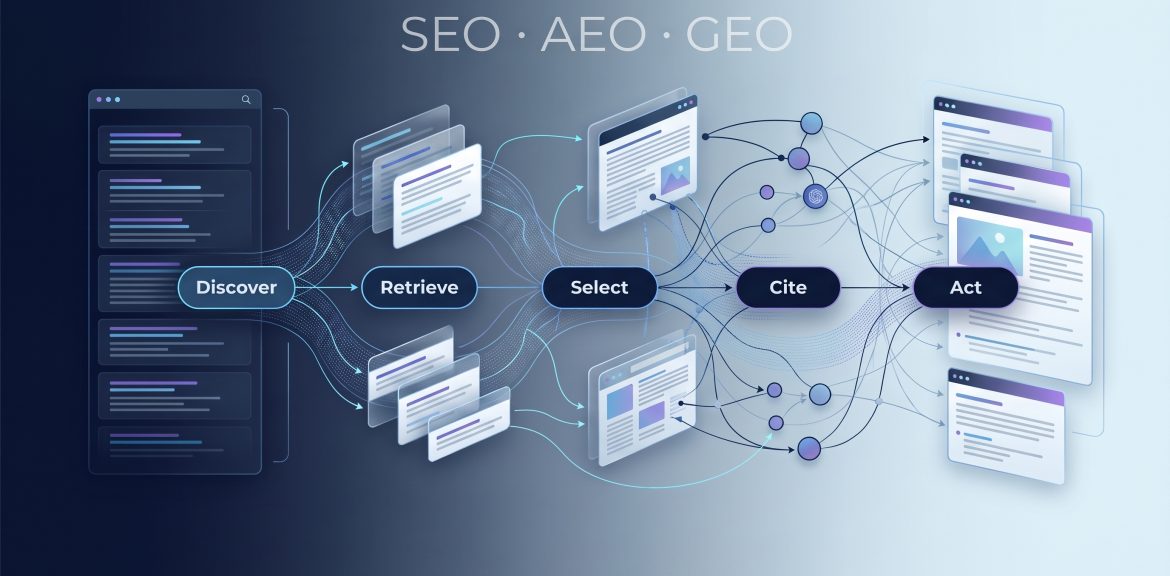
We call that journey the Digital Visibility Stack.
And understanding that stack may be more useful than arguing about whether SEO, AEO or GEO will “win.”
The Short Answer: SEO, AEO and GEO Are Not Replacements for Each Other
SEO is not being replaced by AEO or GEO.
Traditional SEO still provides much of the infrastructure that allows content to be discovered, crawled, indexed, understood and retrieved.
What has changed is what can happen after discovery.
A modern information journey can look like this:
Discovery → Retrieval → Selection → Answer/Citation → Click or Action
A website can therefore succeed at one stage and fail at another.
You may be indexed but never retrieved. You may be retrieved but never selected. You may be cited but contribute almost nothing to the final answer. You may appear prominently in an AI response but receive no click.
Or you may receive fewer visits but attract visitors with much stronger intent.
That is why measuring modern search visibility purely through rankings is becoming incomplete.
Forget the Acronyms for a Minute
Imagine someone asks:
“What’s the best SEO strategy for a small e-commerce business using AI-generated product content?”
Traditional search might return a ranked collection of pages.
A generative system can do something different.
It may break the question into several related information needs, retrieve material from different sources, compare what those sources say and construct an answer.
Google now openly describes two important technologies behind its generative Search experiences: retrieval-augmented generation (RAG) and query fan-out.
RAG allows a generative system to ground an answer using retrieved, current web information.
Query fan-out allows the system to generate multiple related searches around the original question and retrieve supporting information for different aspects of the answer.
This has an important consequence for publishers:
Your page doesn’t necessarily need to be the single best page for the entire question. It may need to be an exceptionally useful source for one important part of it.
That changes how we should think about content.
The Digital Visibility Stack
Instead of treating SEO, AEO and GEO as three competing marketing services, we propose looking at visibility as five connected stages.
Layer 1: Discovery
Can the system find your content?
This is where traditional technical SEO remains fundamental.
The page needs to be accessible, crawlable and indexable. Internal linking needs to make sense. Search engines need to understand the site structure.
A brilliant piece of research hidden behind technical problems is still invisible research.
AI has not eliminated this requirement.
Google’s own guidance for generative Search continues to emphasize technical accessibility and conventional SEO foundations.
Layer 2: Retrieval
Being indexed doesn’t mean being retrieved.
The second challenge is:
When a user asks a relevant question, does the system consider your page relevant enough to bring into the candidate information set?
This is where topical relevance becomes more interesting than simple keyword repetition.
Consider an article about “How AI is changing local SEO.”
An AI system might investigate related concepts such as:
- AI-generated local recommendations
- Google Business Profile visibility
- Reviews and reputation
- Local entity information
- Maps
- Location-specific intent
- AI-assisted purchasing decisions
A strong page therefore needs to understand the problem space, not merely repeat the target phrase throughout the article.
This is one reason old-fashioned keyword-density thinking is becoming increasingly inadequate.
Layer 3: Selection
Now we reach a stage that receives much less attention.
Several relevant pages may be retrieved.
Why should the system trust yours enough to use it?
This is where originality becomes commercially important.
Suppose 100 websites publish:
“10 SEO Trends for 2026.”
They contain essentially the same predictions.
AI search does not need all 100 versions to understand those ideas.
Now imagine one company publishes:
“We Changed 50 Product Pages After Google’s AI Search Expansion — Here Is What Happened Over 90 Days.”
That page contains something different:
Evidence.
The web doesn’t need another rewrite of information it already contains.
It has considerably more reason to retrieve and reference information that adds something new.
This is why we believe information gain should become one of the central ideas behind modern content strategy.
Layer 4: Answer and Citation
This is the territory usually described as AEO or GEO.
But even here, one measurement can be misleading.
Being cited does not necessarily mean your information meaningfully influenced the answer.
Recent GEO research has begun distinguishing between citation selection and citation absorption.
Those are not the same thing.
A system might list a page among several sources while using very little of its information.
Another source might provide the definition, statistic, comparison or evidence around which the answer is constructed.
That creates an important new objective:
Don’t create content merely to be cited. Create information worth using.
Research examining citation behaviour across generative platforms suggests that useful sources often contain characteristics such as clear structure, semantic relevance and extractable evidence, including numerical facts, definitions, comparisons and procedural information.
This doesn’t mean publishers should start manufacturing statistics or artificially chopping articles into “AI-friendly” fragments.
It means that specific information is more useful than vague information.
Compare:
“AI is transforming marketing very quickly.”
with:
“In our 90-day test across 30 campaigns, AI-assisted creative reduced production time by X%, while conversion performance changed by Y%.”
The second statement gives a retrieval system something verifiable to work with.
It also gives the human reader something worth remembering.
Layer 5: Click or Action
This may eventually become the most important layer commercially.
Ranking #1 used to be treated as the victory.
In an answer-driven environment, visibility alone isn’t necessarily the final objective.
A publisher ultimately needs something to happen:
Click → Subscribe → Enquire → Buy → Reference → Share → Return
An AI system might successfully answer an informational question using your research while the user never visits your website.
From a citation perspective, that could look like success.
From an advertising-supported publisher’s perspective, it may produce no immediate revenue.
Therefore the next generation of search measurement needs to connect visibility with economic outcomes.
For an AdSense publisher, that may mean:
- Qualified organic visits
- Pages per visit
- Returning readers
- Engagement
- Geographic traffic quality
- Advertising revenue
For a B2B company, the same visibility might instead be measured through:
- Enquiries
- Branded searches
- Leads
- Assisted conversions
- Authority
- Mentions
The optimization strategy should ultimately follow the business model.
Where Do SEO, AEO and GEO Actually Fit?
Now the acronyms become easier to understand.
SEO — Search Engine Optimization
SEO establishes and improves traditional search visibility.
It covers areas such as:
- Crawlability
- Indexing
- Site architecture
- Page relevance
- Internal linking
- Authority
- User experience
- Traditional organic search visibility
SEO remains the foundation.
Google’s current guidance indicates that its generative Search experiences remain rooted in core Search ranking and quality systems.
The arrival of generative search therefore did not suddenly make technical SEO irrelevant.
AEO — Answer Engine Optimization
AEO is generally used to describe making information suitable for direct-answer environments.
The objective is not simply:
“Can this page rank?”
but:
“Can this information clearly answer the question?”
Good AEO therefore tends to favour clarity.
Not robotic writing.
Not stuffing dozens of FAQs into every article.
Not writing every heading as a question because someone said AI likes questions.
Simply make important information understandable.
GEO — Generative Engine Optimization
GEO generally describes improving visibility within generative systems such as AI search and conversational answer engines.
This can include being:
- Discovered
- Retrieved
- Cited
- Mentioned
- Incorporated into an answer
But GEO currently deserves some caution.
The industry is moving faster than the evidence.
Recent research reviewing the developing GEO evidence base has not demonstrated a universal technique that reliably creates stable, long-term, cross-platform organic visibility.
That’s important.
It means anyone promising a guaranteed formula for “ranking #1 in ChatGPT” deserves scrutiny.
Generative systems differ. Their sources change. Prompts change. Retrieval changes. Answers can change between runs.
GEO is real as an optimization problem.
GEO magic tricks are another matter.
Google’s Position Is Surprisingly Simple
Google’s current guidance makes its position fairly clear.
From Google’s perspective, optimizing for generative Search remains closely connected to SEO fundamentals.
Google warns publishers against becoming distracted by supposed AI-search hacks.
For example:
- There is no special structured data required purely for Google’s generative Search features.
- Google does not require publishers to divide articles into tiny “AI-readable” chunks.
- Google Search does not require
llms.txtfor visibility.
That doesn’t mean every technology outside Google’s ecosystem behaves identically.
It does mean marketers should be cautious when someone presents a newly invented technical requirement as essential for “AI SEO.”
The Real Opportunity: Become the Source
This leads to what we believe is one of the most important content principles for 2026 and beyond:
Stop asking only, “How do we rank this article?” Start asking, “What would make another human—or an AI system—need this article as a source?”
That changes editorial planning completely.
A generic article starts with a keyword.
A source-worthy article can start with:
- An experiment
- A dataset
- A customer pattern
- A contradiction
- A new technology
- A failed assumption
- A benchmark
- An expert observation
- A documented case study
- A comparison nobody has tested properly
- A question existing results don’t answer
AI can summarize existing knowledge extraordinarily well.
That means publishers may create more value by producing knowledge that did not previously exist.
The Commodity Content Problem
Imagine ten agencies ask an AI system:
“Write a 2,000-word article about the latest SEO trends.”
Even with different wording, the underlying information will probably converge.
The articles may all discuss AI search, user experience, helpful content, structured data and authority.
Technically, every article might be “original” according to a plagiarism checker.
Informationally, almost none of them is original.
That distinction matters.
Linguistic Originality vs Informational Originality
Linguistic originality means the sentences are different.
Informational originality means the reader learns something they could not have learned from the existing collection of pages.
Modern publishing needs more of the second.
A Better Content Test for 2026
Before publishing an article, ask five questions.
1. What Does This Page Know?
Does it contain actual knowledge, evidence or experience—or merely prose?
2. What Does This Page Add?
If the top ten results disappeared tomorrow, would this article restore something unique to the web?
3. What Can Be Verified?
Are claims supported by evidence, primary documentation, research, transparent methodology or first-hand experience?
4. What Can Be Extracted?
Can a reader quickly locate the important definition, finding, process, comparison or conclusion?
5. Why Should Anyone Visit?
After an AI-generated summary exists, does the original page still offer enough depth, evidence, tools, visuals, methodology or insight to deserve the click?
If we cannot answer those questions convincingly, more keywords probably won’t solve the problem.
What We Are Testing at The Digital Edge
We don’t want this publication merely to tell readers what GEO supposedly does.
We’re going to test it.
Beginning in September 2026, The Digital Edge is rebuilding its editorial strategy around research-led, non-commodity content.
Instead of mass-producing articles from keyword lists, our publishing model will prioritize:
Primary-source research → Current evidence → Original analysis → Practical experiments → Transparent results
Over the coming months, we plan to track how this content performs across traditional Google Search and emerging generative discovery environments.
Where possible, we’ll publish the results—including experiments that fail.
That last part matters.
If a GEO technique produces no measurable improvement, that’s information too.
What Should Businesses Do Right Now?
Don’t abandon SEO.
Don’t create three disconnected teams because three acronyms are trending.
And don’t rebuild your website around unproven AI-search hacks.
Start with a simpler hierarchy.
Make the site discoverable.
Then make the content relevant enough to retrieve.
Make the information distinctive enough to select.
Make the evidence useful enough to cite.
And make the destination valuable enough to visit.
That is the Digital Visibility Stack:
Discover → Retrieve → Select → Cite → Act
SEO, AEO and GEO can all contribute to it.
But none of those acronyms changes the underlying objective:
Become the most useful source you can genuinely be.
Final Thought: Search Is Moving From Finding Information to Choosing Sources
The first era of SEO rewarded websites for making information easier to find.
The emerging era may increasingly reward websites for making better information worth finding.
That’s a subtle difference, but potentially an enormous one.
AI can produce another article about almost anything.
What it cannot independently produce is your real experiment, your customer experience, your proprietary dataset, your newly observed pattern or the evidence you haven’t collected yet.
The future of content therefore may not belong to whoever publishes the most.
It may belong to whoever contributes the most new knowledge.
And that is where we believe modern search optimization should begin.
Research & Methodology
This article was developed by The Digital Edge at Lanka E-Marketing using current Google Search documentation, recent research into generative-engine optimization and citation behaviour, and analysis of how SEO, AEO and GEO interact across modern information-discovery systems.
The Digital Visibility Stack — Discover → Retrieve → Select → Cite → Act is The Digital Edge’s editorial framework for understanding this changing search journey.
Editorial approach: We prioritize primary sources, current research, practical testing and clearly identified original analysis rather than rewriting existing search results.


